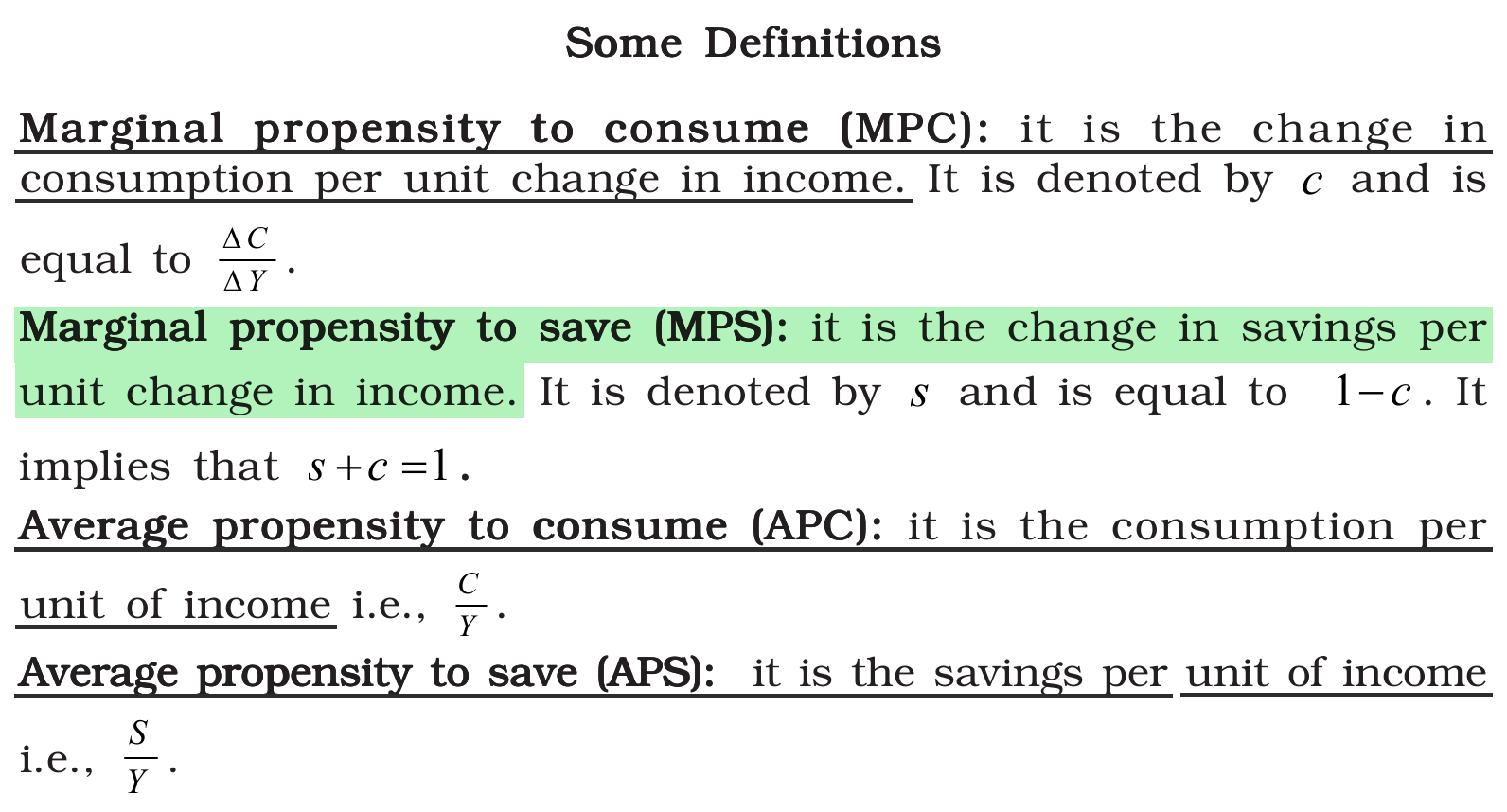
MPS is defined as :
Answer & explanation
Correct answer: option 4
The correct answer is Option (4) → Change in savings per unit change in income
The marginal propensity to save (MPS) tells how much of each extra rupee of income is saved. If income rises by Rs 100 and savings rise by Rs 20, the MPS is 0.2.
Option (1) Change in consumption per unit change in Income — Incorrect. This is the marginal propensity to consume (MPC). It looks at consumption, and the MPS looks at savings.
Option (2) Change in consumption per unit of Income — Incorrect. This also looks at consumption. The average propensity to consume (APC) is the consumption per unit of income.
Option (3) Change in savings per unit of Income — Incorrect. The MPS relates a change in savings to a change in income, and this option leaves that out. The average propensity to save (APS) is the savings per unit of income.
Option (4) Change in savings per unit change in income — Correct. Both savings and income are taken as changes, and this is the definition of the MPS.
Note: A same/similar question was asked in CUET (UG) in the papers below.
| 2026 | 2025 | 2024 | 2023 | 2022 |
| 06-06 S1* | – | – | 05-06 S1 | – |
* A similar question.
NCERT (2026-27): Introductory Macroeconomics — Chapter 4: Determination of Income and Employment
|