Read the passage carefully and answer the following questions.
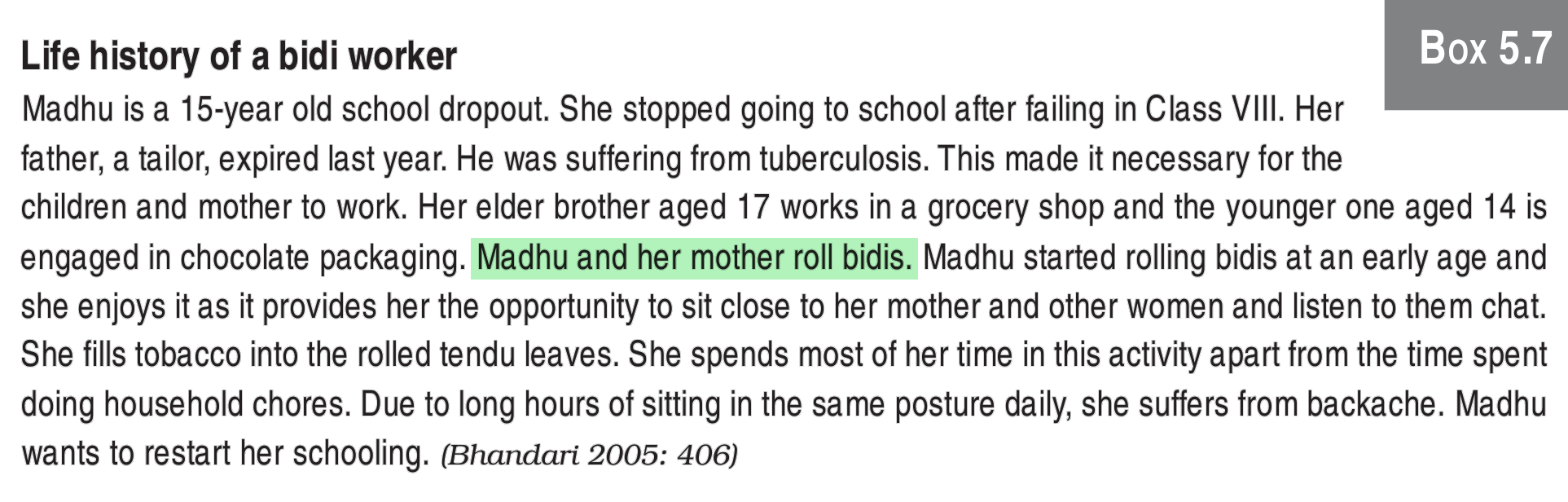
Madhu is a 15-year old school dropout. She stopped going to school after failing in class VIII. Her father, a tailor, expired last year. He was suffering from tuberculosis. This made it necessary for the children and their mother to work. Her elder brother aged 17 years works in a grocery shop and the younger one aged 14 years is engaged in chocolate packaging. Madhu and her mother roll bidi. Madhu started rolling bidis at an early age and she enjoys it as it provides her the opportunity to sit close to her mother and other women and listen to their chat. She fills tobacco into the rolled tendu leaves. She spends most of her time in this activity apart from the time spent doing household chores. Due to long hours of sitting in the same posture daily, she suffers from backpain. Madhu wants to restart her schooling.
Which kind of a work is getting reflected in the passage?
Answer & explanation
Correct answer: option 3
The correct answer is Option (3) → Home Based work
Option (1) Manufacturing work — Incorrect. Manufacturing means making goods, and home-based work does include the manufacture of bidis, lace, carpets and agarbattis. But the word only says that something is being made; it does not say where and how the work is done. The passage shows a particular form of it: Madhu rolls bidis at home, beside her mother, and such work is paid by the piece. That is home-based work, the most appropriate answer.
Option (2) Governmental work — Incorrect. Government work means a job in a government office or department, with a regular salary. Madhu has no employer of that kind; she and her mother roll bidis together.
Option (3) Home Based work — Correct. Home-based work is the making of products such as lace, zari, carpets, bidis and agarbattis by workers in their own homes. An agent provides the raw materials and picks up the finished product, and the workers are paid on a piece-rate basis. This work is mainly done by women and children, as with Madhu and her mother.
Option (4) Industrial work — Incorrect. Industrial work is done in factories, under a detailed division of labour and fixed working hours. Madhu works at home beside her mother, outside any factory.
Note 1: Box 5.7, ‘Life history of a bidi worker’, from which this passage is taken, was there in the pre-rationalised NCERT, which NTA followed in 2023, and has been deleted from the NCERT book (2025-26). The section on home-based work is still there.
Note 2: Bidi rolling is manufacturing in the broad sense, so Option (1) is not false in itself. The answer rests on reasoning: the question asks which kind of work the passage reflects, and the passage describes work done in the worker’s own home, which NCERT names home-based work. Of the two, Option (3) is the most appropriate answer.
NCERT (2025-26): “5.6 Home-based work … Home-based work is an important part of the economy. This includes the manufacture of lace, zari or brocade, carpets, bidis, agarbattis and many such products. This work is mainly done by women and children. An agent provides raw materials and also picks up the finished product. Home workers are paid on a piece-rate basis, depending on the number of pieces they make.…”
Box 5.7, Life history of a bidi worker (Pre-rationalised NCERT) |