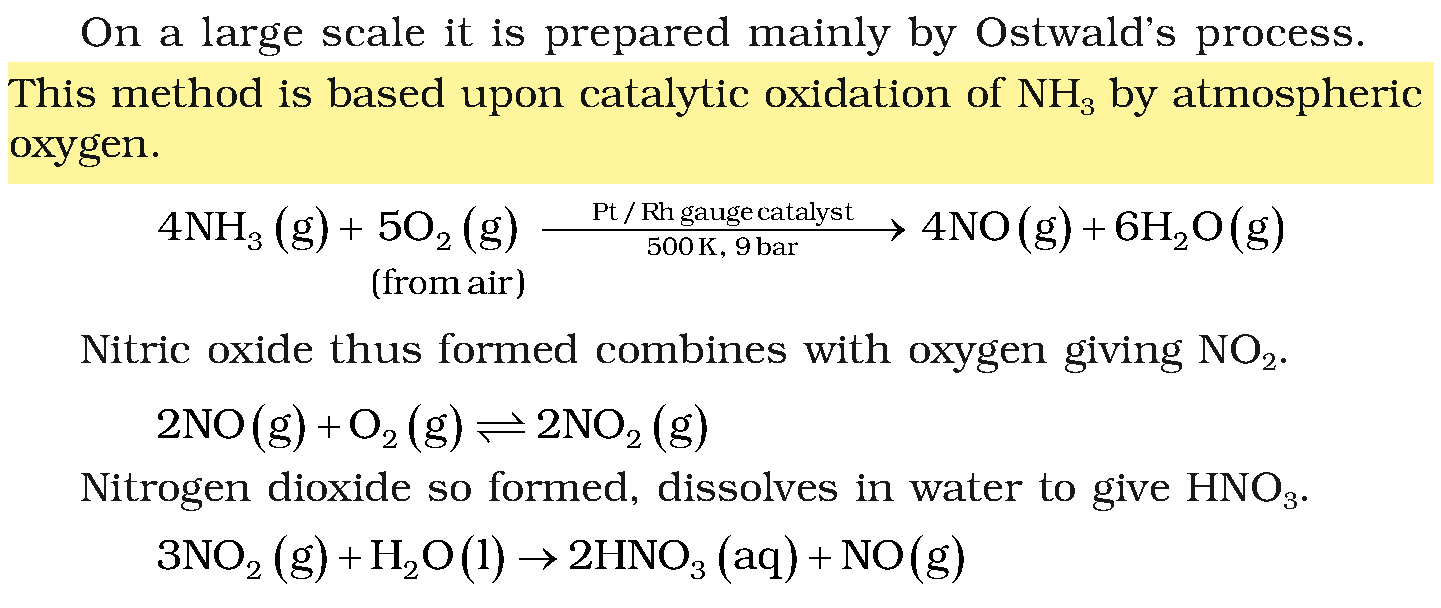
Ostwald’s process for the manufacture of nitric acid involves three steps. Arrange them in correct sequence:
A. 3NO2(g) + H2O(l) → 2HNO3(aq) + NO(g)
B. 2NO(g) + O2(g) → 2NO2(g)
C. \(4NH_3(g) + 5O_2(g) \xrightarrow[500\ K,\ 9\ bar]{catalyst} 4NO(g) + 6H_2O(g)\)
Choose the correct answer from the options given below:
Answer & explanation
Correct answer: option 4
The correct answer is Option (4) → C, B, A
In Ostwald’s process, nitric acid is made by catalytic oxidation of ammonia, in three steps:
C. Ammonia is oxidised by air over a Pt/Rh gauze catalyst to nitric oxide:
\( \displaystyle \ce{4NH3(g) + 5O2(g)} \xrightarrow[500\ \mathrm{K},\ 9\ \mathrm{bar}]{\text{Pt/Rh gauze}} \ce{4NO(g) + 6H2O(g)} \)
B. Nitric oxide combines with oxygen to give nitrogen dioxide:
\( \displaystyle \ce{2NO(g) + O2(g) <=> 2NO2(g)} \)
A. Nitrogen dioxide dissolves in water to give nitric acid; the NO formed is recycled:
\( \displaystyle \ce{3NO2(g) + H2O(l) -> 2HNO3(aq) + NO(g)} \)
Shortcut: The process starts from ammonia, so the first step is C; of Options (2) and (4), which start with C, only Option (4) puts the formation of \( \ce{NO2} \) (B) before its reaction with water (A).
Note: This question is from the pre-rationalised NCERT book (2022-23). The topic is not there in the latest NCERT book (2026-27), and it is also out of the CUET 2026 syllabus.
NCERT (Pre-rationalised edition, 2022-23):
Nitric Acid – …