If \(\tan^{-1}x=y\), then
Answer & explanation
Correct answer: option 1
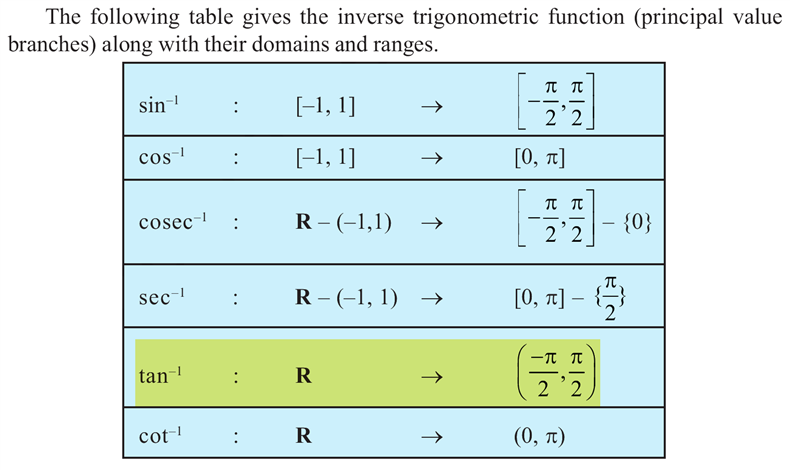
The correct answer is Option (1) → \(x \in R, y \in \left(-\displaystyle\frac{\pi}{2}, \frac{\pi}{2}\right)\)
\(\tan^{-1}x = y\) means \(\tan y = x\) with y in the principal value branch of \(\tan^{-1}\).
tan takes every real value on \(\left(-\frac{\pi}{2}, \frac{\pi}{2}\right)\), so \(\tan^{-1}x\) is defined for every real x: the domain is R.
The principal value branch, the range, is the open interval \(\left(-\frac{\pi}{2}, \frac{\pi}{2}\right)\).
So \(x \in R\) and \(y \in \left(-\frac{\pi}{2}, \frac{\pi}{2}\right)\).
Why the other options are incorrect
Option (2) \(x \in \left(-\displaystyle\frac{\pi}{2}, \frac{\pi}{2}\right), y \in R\) — Incorrect. This swaps the domain and the range.
Option (3) \(x \in R, y \in \left[-\displaystyle\frac{\pi}{2}, \frac{\pi}{2}\right]\) — Incorrect. tan is not defined at \(\pm\frac{\pi}{2}\), so y never takes these end values; the interval is open.
Option (4) \(x \in [-1, 1], y \in \left(-\displaystyle\frac{\pi}{2}, \frac{\pi}{2}\right)\) — Incorrect. [−1, 1] is the domain of \(\sin^{-1}\) and \(\cos^{-1}\); \(\tan^{-1}x\) is defined for every real x.
NCERT (2026-27 edition):
Basic Concepts