Read the following passage and answer the next five questions based on it.
| Sc | Ti | V | Cr | Mn | Fe | Co | Ni | Cu | Zn |
| Y | Zr | Nb | Mo | Tc | Ru | Rh | Pd | Ag | Cd |
| La | Hf | Ta | W | Re | Os | Ir | Pt | Au | Hg |
In any transition series, as we move from left to right the d-orbitals are progressively filled and their properties vary accordingly.
| Ce | Pr | Nd | Pm | Sm | Eu | Gd | Tb | Dy | Ho | Er | Tm | Yb | Lu |
| Th | Pa | U | Np | Pu | Am | Cm | Bk | Cf | Es | Fm | Md | No | Lr |
The above are the two series of f-block elements in which the chemical properties won’t change much. The 5f-series elements are radioactive in nature and mostly are artificially synthesized in laboratories and thus much is not known about their chemical properties.
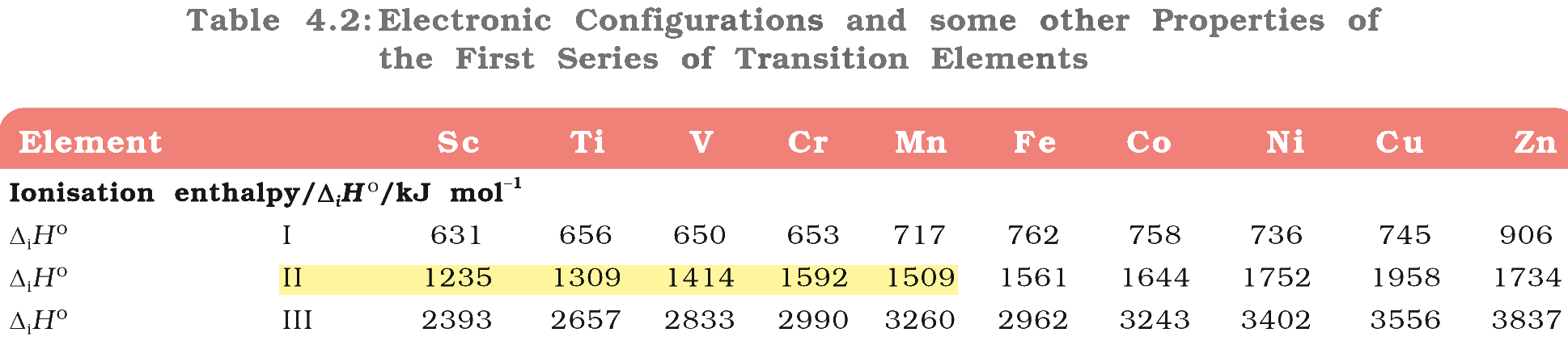
Which of the following is the correct order of second ionisation enthalpy ?
Answer & explanation
Correct answer: option 3
The correct answer is Option (3) → V < Cr > Mn
The second ionisation enthalpy is the energy needed to remove an electron from the \( \ce{M+} \) ion. It is unusually high when \( \ce{M+} \) has a stable configuration (half-filled d5 or full d10), because the second electron must then be taken out of that stable subshell.
The configurations of the three \( \ce{M+} \) ions are:
V (Z = 23): [Ar]3d34s2, so \( \ce{V+} \) is [Ar]3d34s1. The second electron comes from 4s and the nuclear charge is the lowest of the three: first (lowest).
Cr (Z = 24): [Ar]3d54s1, so \( \ce{Cr+} \) is [Ar]3d5. The second electron must break the half-filled 3d5 subshell: the highest of the three.
Mn (Z = 25): [Ar]3d54s2, so \( \ce{Mn+} \) is [Ar]3d54s1. The second electron comes from 4s and leaves the stable 3d5 behind: between V and Cr.
Shortcut: \( \ce{Cr+} \) is the only one of the three ions with a 3d5 configuration, so Cr must have the highest value. Only Option (3) puts Cr above both V and Mn.
NCERT (2026-27 edition):
Trends in the M2+/M Standard Electrode Potentials – …