
Read the information given below to answer
In Young’s double slit experiment as shown in figure, interference of light waves were observed on the screen. Thomas Young made two pinholes \( S_1 \) and \( S_2 \) (very close to each other) on an opaque screen in front of parent source \( S \)
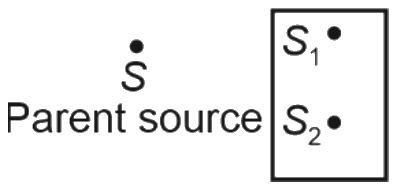
\( S_1 \) and \( S_2 \) behaved as coherent sources, and produced interference pattern on the screen which has alternate bright fringe and dark fringes. This experiment proved Huygens’ wave theory of Light.
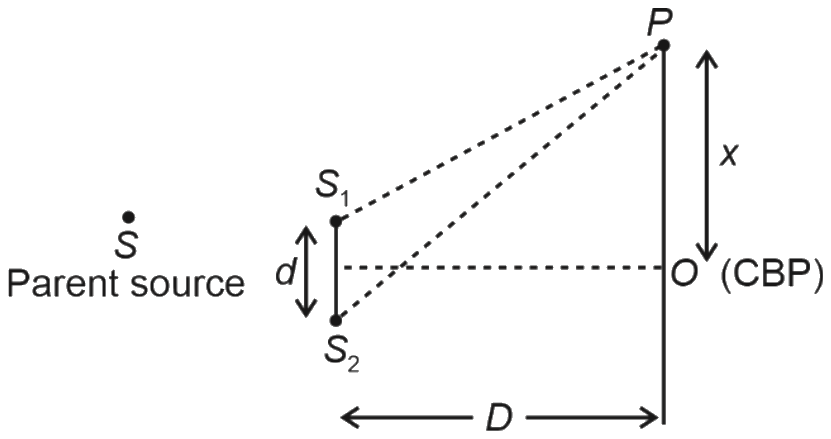
In YDSE 20th bright fringe is obtained 20 mm distance from central bright point. The distance between the 5th bright fringe and 3rd dark fringe is
Answer & explanation
Correct answer: option 3
The correct answer is Option (3) → 2.5 mm
Measured from the central bright point, the \( n \)th bright fringe is at \( n\beta \) and the \( n \)th dark fringe is at \( (n - 1/2)\beta \), where \( \beta = \lambda D/d \) is the fringe width.
\( 20\beta = 20\,\mathrm{mm} \;\Rightarrow\; \beta = 1\,\mathrm{mm} \)
\( \text{5th bright: } y_5 = 5\beta = 5\,\mathrm{mm} \)
\( \text{3rd dark: } y'_3 = 2.5\beta = 2.5\,\mathrm{mm} \)
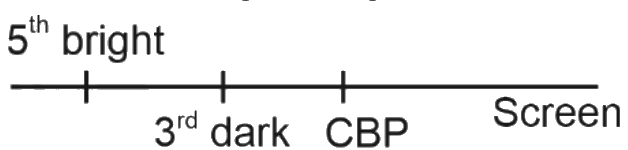
The figure shows both fringes on the same side of the central bright point, so
\( y_5 - y'_3 = 5 - 2.5 = 2.5\,\mathrm{mm} \)