Match List-I with List-II
| List-I | List-II |
| (A) Increase in consumers' income | (I) Budget line becomes flatter |
| (B) Decrease in price of good on X axis | (II) No change in the slope of budget line |
| (C) Equal increase in price of both good X and good Y | (III) Parallel and rightward shift in their budget line |
| (D) Decrease in Price of the good on Y axis | (IV) Budget line becomes steeper |
Choose the correct answer from the options given below:
Answer & explanation
Correct answer: option 2
The correct answer is Option (2) → (A)-(III), (B)-(I), (C)-(II), (D)-(IV)
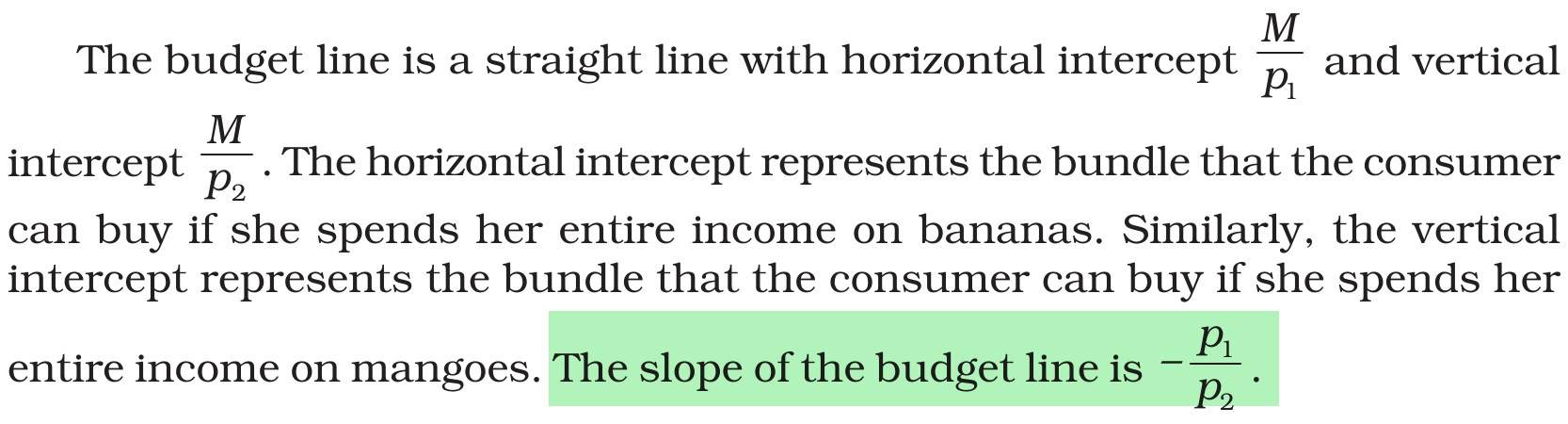
The steepness of the budget line depends on the price ratio. This is the price of the good on the X axis divided by the price of the good on the Y axis. A larger ratio gives a steeper line, and a smaller ratio gives a flatter line.
| List-I | List-II | Reason |
|---|---|---|
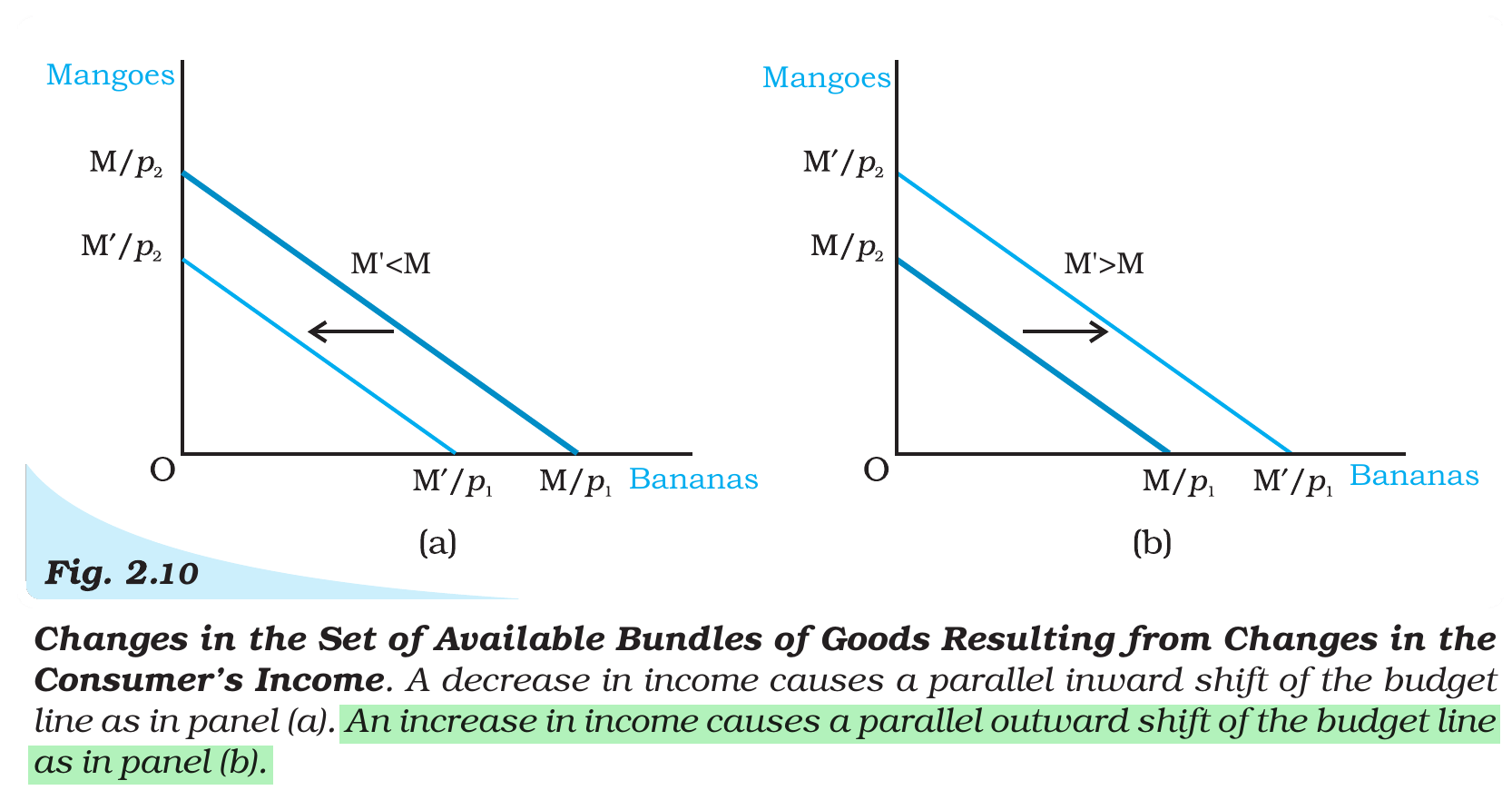
| (A) Increase in consumers’ income | (III) Parallel and rightward shift in their budget line | The line meets both axes further out, but the prices stay the same. So the slope does not change, and the line moves outward. |
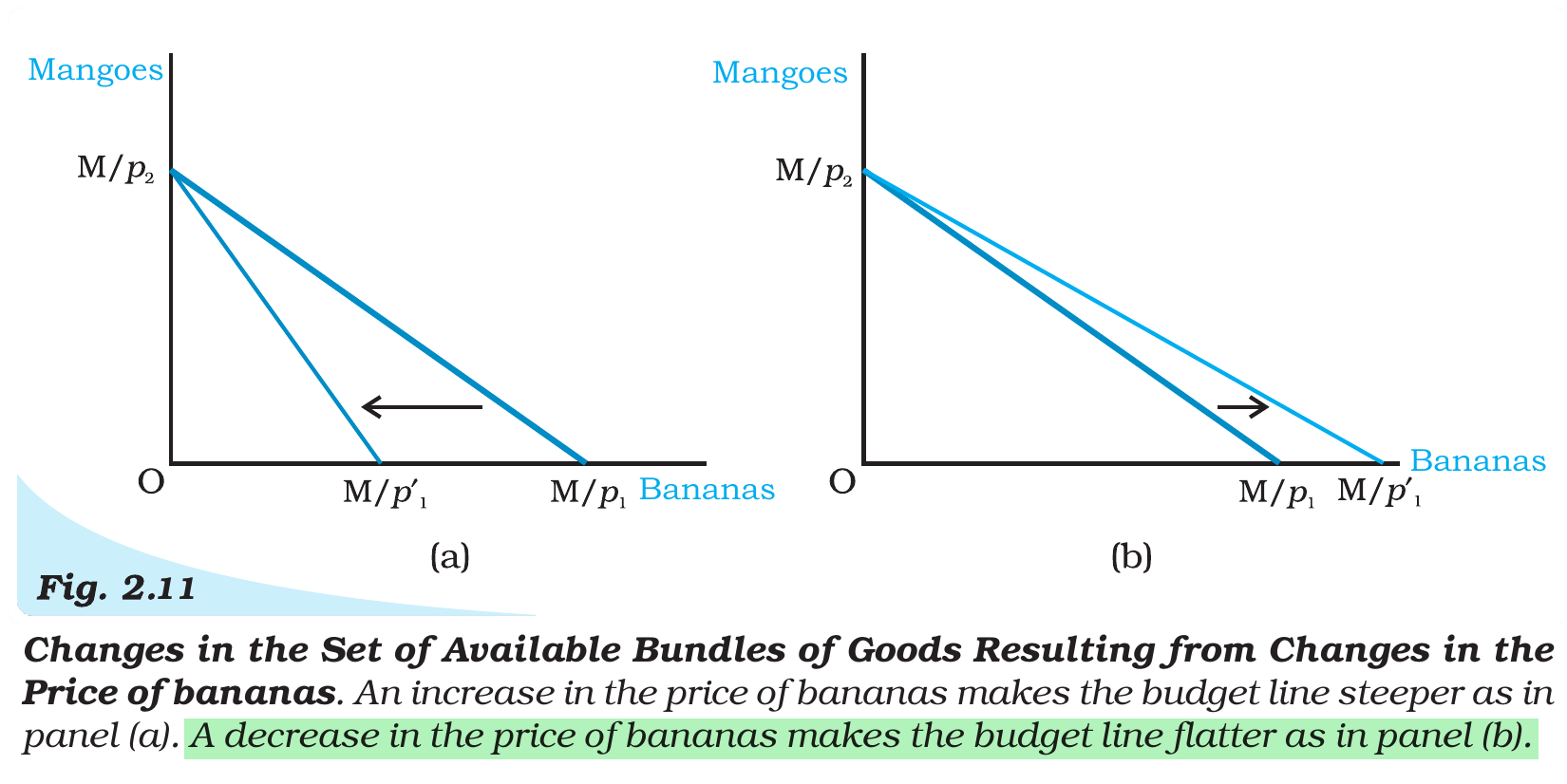
| (B) Decrease in price of good on X axis | (I) Budget line becomes flatter | The price ratio falls. The line pivots outwards around its point on the Y axis. |
| (C) Equal increase in price of both good X and good Y | (II) No change in the slope of budget line | If both prices rise in the same proportion, the price ratio stays the same. The line moves inward with the same slope. |
| (D) Decrease in Price of the good on Y axis | (IV) Budget line becomes steeper | The bottom of the ratio falls, so the price ratio rises. The line pivots outwards around its point on the X axis. |
Note 1: It seems that there is a mistake in the original NTA question. Item (C) says ‘equal increase’ in both prices. The slope stays the same only when both prices rise in the same proportion, not by the same amount. For example, let the prices be Rs 10 and Rs 20, so the price ratio is 1/2.
If both double, to Rs 20 and Rs 40, the ratio stays 1/2.
If both rise by Rs 10, to Rs 20 and Rs 30, the ratio becomes 2/3 and the slope changes.
So (C)-(II) holds only for a rise in the same proportion, which is what the question should say.
Note 2: One item of List-I fits two entries of List-II:
(A) Increase in consumers’ income → both (II) and (III). A parallel shift leaves the slope unchanged.
NCERT (2026-27): “2.2.2 Changes in the Budget Set … Note that the slope of the new budget line is the same as the slope of the budget line prior to the change in the consumer’s income. However, the vertical intercept has changed after the change in income. If there is an increase in the income, i.e. if M' > M, the vertical as well as horizontal intercepts increase, there is a parallel outward shift of the budget line.… …Note that the vertical intercept of the new budget line is the same as the vertical intercept of the budget line prior to the change in the price of bananas. However, the slope of the budget line and horizontal intercept have changed after the price change. If the price of bananas increases, ie if p'1 > p1, the absolute value of the slope of the budget line increases, and the budget line becomes steeper (it pivots inwards around the vertical intercept and horizontal intercept decreases). If the price of bananas decreases, i.e., p'1 < p1, the absolute value of the slope of the budget line decreases and hence, the budget line becomes flatter (it pivots outwards around the vertical intercept and horizontal intercept increases). Figure 2.11 shows change in the budget set when the price of only one commodity changes while the price of the other commodity as well as income of the consumer are constant. A change in price of mangoes, when price of bananas and the consumer’s income remain unchanged, will bring about similar changes in the budget set of the consumer.”
|