
Observe the figures I and II and answer the following questions.
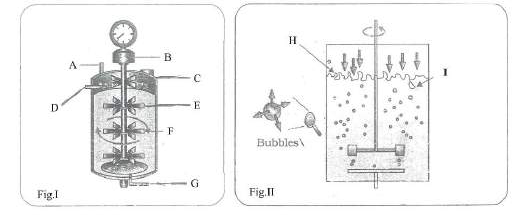
What is the role of bubbles as shown in figure II?
Answer & explanation
Correct answer: option 1
The correct answer is Option (1) → To increase the oxygen transfer area
Figure II is a sparged stirred-tank bioreactor: sterile air is blown into the culture as many small bubbles. Many small bubbles have a much larger total surface than one big stream of air, so more oxygen passes into the culture.
Option (1) To increase the oxygen transfer area — Correct. In a sparged stirred-tank bioreactor, air is bubbled through the medium. The bubbles increase the area for oxygen transfer, so the growing cells get more oxygen.
Option (2) To decrease the oxygen transfer area — Incorrect. Blowing air in as small bubbles increases the surface through which oxygen passes. A smaller transfer area would give the cells less oxygen, the opposite of the aim of sparging.
Option (3) To increase the solubility of other gases — Incorrect. The bubbles are of sterile air, sent in to supply oxygen; they do not change how well a gas dissolves.
Option (4) To increase the solubility of salts — Incorrect. Salts are dissolved in the medium; air bubbles have no role in this.
NCERT Extract:
Obtaining the Foreign Gene Product – “… A stirred-tank reactor is usually cylindrical or with a curved base to facilitate the mixing of the reactor contents. The stirrer facilitates even mixing and oxygen availability throughout the bioreactor. Alternatively air can be bubbled through the reactor. If you look at the figure closely you will see that the bioreactor has an agitator system, an oxygen delivery system and a foam control system, a temperature control system, pH control system and sampling ports so that small volumes of the culture can be withdrawn periodically.”