
Statement-1: If a transversal cuts the sides OL, OM and diagonal ON of a parallelogram at A, B, C respectively, then $\frac{OL}{OA}+\frac{OM}{OB}=\frac{ON}{OC}$
Statement-2: Three points with position vectors $\vec a, \vec b,\vec c$ are collinear iff there exist scalars $x, y, z$ not all zero such that $x\vec a+y\vec b +z\vec c =\vec 0$, where $x + y + z = 0$.
Answer & explanation
Correct answer: option 1
Statement-2 is true.
Let $\vec{OL} = x\vec{OA}, \vec{OM} = y\vec{OB}$ and $\vec{ON} =z\vec{OC}$. Then,
$|\vec{OL}|=x|\vec{OA}||\vec{OM}|=y|\vec{OB}|$ and $|\vec{ON}|=z|\vec{OC}|$
$⇒x=\frac{OL}{OA},y=\frac{OM}{OB},z=\frac{ON}{OC}$
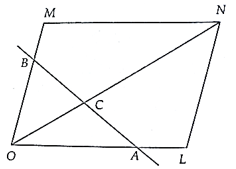
Taking O as the origin, let the position vectors of A, B, C be $\vec a,\vec b$ and $\vec c$ respectively.
In ΔOLN, we have
$\vec{OL} + \vec{LN} = \vec{ON}$
$⇒\vec{ON} -\vec{OL}+\vec{OM}$
$⇒z\vec{OC} = x\vec{OA} + y\vec{OB}$
$⇒x\vec{OA} + y\vec{OB}-z\vec{OC}=\vec 0⇒ x\vec a+y\vec b+(-z) \vec c = \vec 0$
But, points A, B, C are collinear.
$∴x\vec a+y\vec b+(-z)\vec c=\vec 0$
$⇒x+y-z=0⇒x+y=z⇒\frac{OL}{OA}+\frac{OM}{OB}=\frac{ON}{OC}$
So statement-1 is also true and statement-2 is a correct explanation for statement-1.