Bag I contains 4 red and 5 black balls, while another Bag II contains 5 red and 6 black balls. One ball is drawn at random from one of the bags and it is found to be black. Then the probability that it was drawn from Bag II, is
Answer & explanation
Correct answer: option 1
The correct answer is Option (1) → \(\displaystyle\frac{54}{109}\)
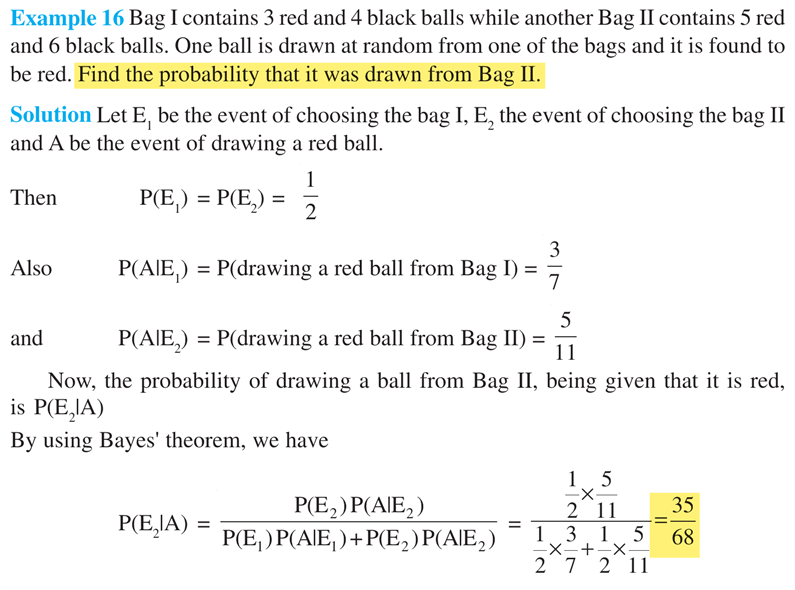
Let \(E_1\), \(E_2\) be the events that Bag I, Bag II is chosen, and B the event that the ball drawn is black.
\( \displaystyle P(E_1) = P(E_2) = \frac{1}{2} \)
\( \displaystyle P(B \mid E_1) = \frac{5}{9},\quad P(B \mid E_2) = \frac{6}{11} \)
By Bayes’ theorem:
\( \displaystyle P(E_2 \mid B) = \frac{P(E_2)\,P(B \mid E_2)}{P(E_1)\,P(B \mid E_1) + P(E_2)\,P(B \mid E_2)} \)
The factors \(\frac{1}{2}\) cancel:
\( \displaystyle P(E_2 \mid B) = \frac{\frac{6}{11}}{\frac{5}{9} + \frac{6}{11}} \)
\( \displaystyle \frac{5}{9} + \frac{6}{11} = \frac{55 + 54}{99} = \frac{109}{99} \)
\( \displaystyle P(E_2 \mid B) = \frac{6}{11}\times\frac{99}{109} = \frac{54}{109} \)
NCERT (2026-27 edition):
Bayes' Theorem