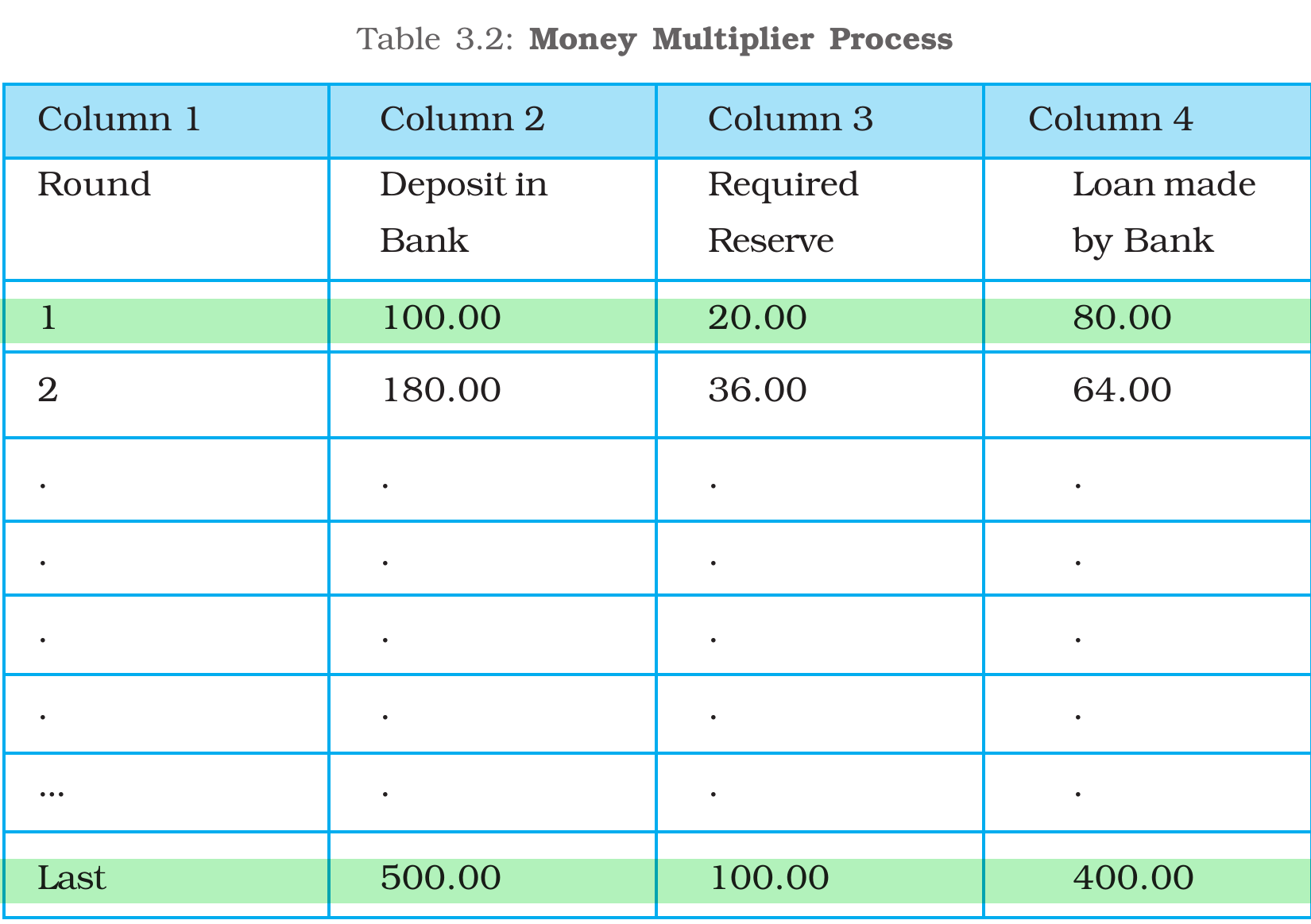
Money Multiplier Process
| Column 1 | Column 2 | Column 3 | Column 4 |
| Round | Deposit in Bank | Required Reserve | Loan made by Bank |
| 1 | 100.00 | 20.00 | 80.00 |
| 2 | 180.00 | 36.00 | 64.00 |
| - | - | - | - |
| - | - | - | - |
| - | - | - | - |
| - | - | - | - |
| - | - | - | - |
| Last | 500.00 | 100.00 | 400.00 |
The first column lists each round. The second column depicts the total deposits with the Bank at the beginning of each round. Twenty percent of these deposits need to be deposited with the RBI as required reserves (column 3). What the Bank lends in each round gets added to the deposits with the bank in the next round. Column 4 indicates the Loans made by the banks.
From the above table, find cash reserve ratio.
Answer & explanation
Correct answer: option 3
The correct answer is Option (3) → 0.2
Given (Round 1):
Required reserve = 20.00
Deposit = 100.00
The cash reserve ratio (CRR) is the share of deposits that banks must keep as reserves. So it is the required reserve divided by the deposit.
CRR = 20.00 / 100.00
CRR = 0.2
The last round gives the same result: 100.00 / 500.00 = 0.2.
NCERT (2026-27): “3.3.2 Limits to Credit Creation and Money Multiplier … In our fictional example, suppose CRR = 20 per cent, then with deposits of Rs 100, our bank will need to keep Rs 20 (20 per cent of 100) as cash reserves. Only the remaining amount of deposits, i.e., Rs 80 (100 – 20 = 80) can be used to give loans. The statutory requirement of the reserve ratio acts as a limit to the amount of credit that banks can create.…”
|