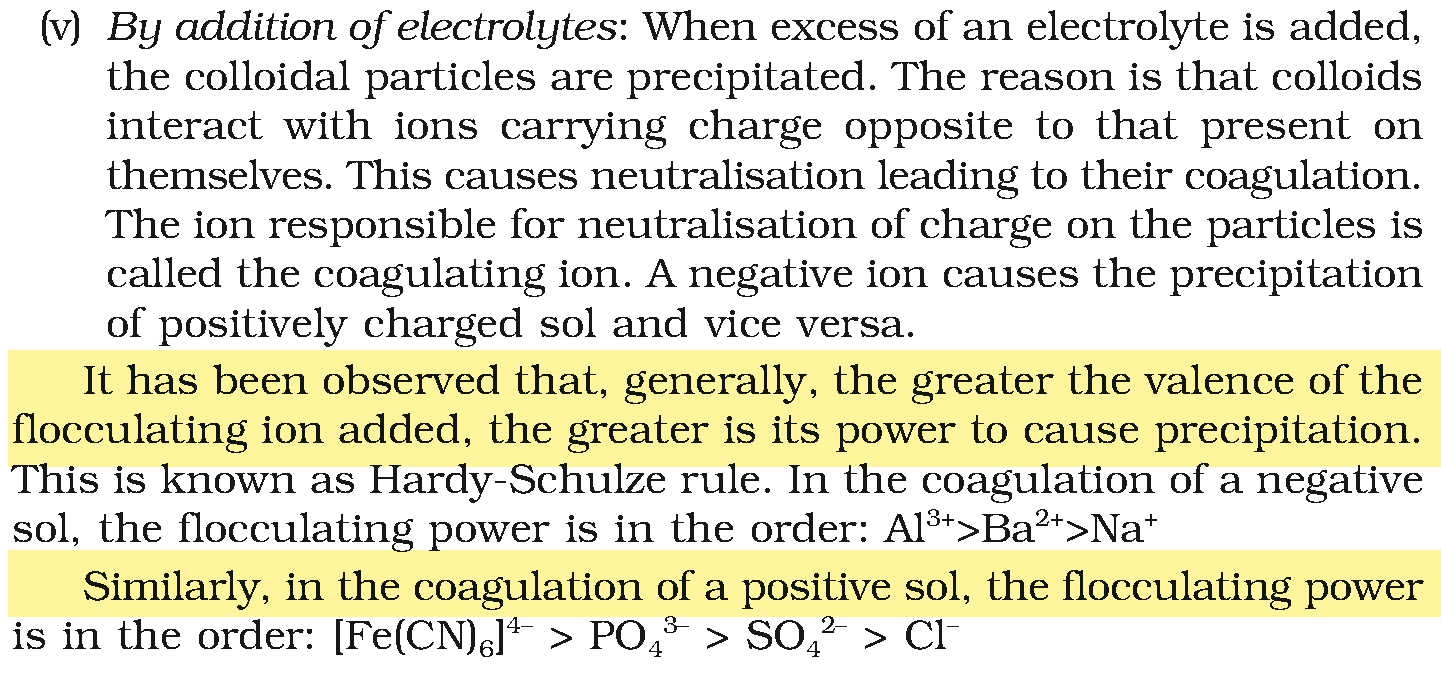
Consider the case when a highly diluted solution of KI is added to AgNO3 solution. Arrange the following in the increasing order of ease of coagulation of the resulting sol.
A. BaSO4
B. NaCl
C. Na3PO4
D. K4[Fe(CN)6]
Choose the correct answer from the options given below:
Answer & explanation
Correct answer: option 4
The correct answer is Option (4) → B < A < C < D
When a very dilute KI solution is added to \( \ce{AgNO3} \), \( \ce{Ag^{+}} \) ions are in excess. The silver iodide formed adsorbs these \( \ce{Ag^{+}} \) ions, so a positively charged sol, AgI/\( \ce{Ag^{+}} \), is obtained:
\( \ce{AgNO3} \text{ (excess)} + \ce{KI -> AgI/Ag^+} \text{ (positive sol)} + \ce{KNO3} \)
A positive sol is coagulated by the anions of the electrolyte added, and the higher the charge (valence) of the anion, the greater its coagulating power.
The anions supplied by the given electrolytes, from the weakest to the strongest coagulating power (\( \ce{BaSO4} \) is practically insoluble in water; the question takes it as a source of \( \ce{SO4^2-} \) ions):
B. NaCl: \( \ce{Cl^{-}} \), charge 1 — first (least effective)
A. \( \ce{BaSO4} \): \( \ce{SO4^{2-}} \), charge 2 — second
C. \( \ce{Na3PO4} \): \( \ce{PO4^{3-}} \), charge 3 — third
D. \( \ce{K4[Fe(CN)6]} \): \( \ce{[Fe(CN)6]^{4-}} \), charge 4 — last (most effective)
Shortcut: NaCl (B) has the singly charged anion and \( \ce{K4[Fe(CN)6]} \) (D) the most highly charged one. Only Option (4) starts with B and ends with D.
Note: This question is from the pre-rationalised NCERT book (2022-23). The topic is not there in the latest NCERT book (2026-27), and it is also out of the CUET 2026 syllabus.
NCERT (Pre-rationalised edition, 2022-23):
Coagulation or Precipitation – …