
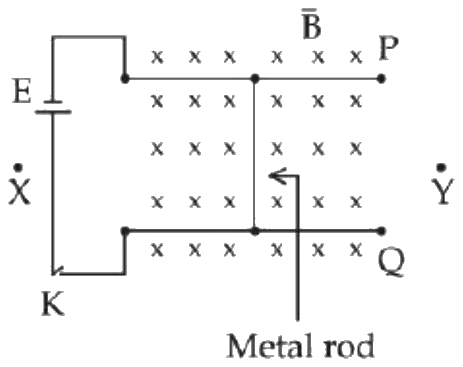
Two conducting rails P and Q are held parallel to each other in the plane of the paper. There is uniform magnetic field ‘B’ perpendicular to the length of the rails going into the paper. A metal rod is kept touching both the rails and is perpendicular to the rails. A dc source is connected, with switch K, to the ends of the rails on one side as shown in the figure. Select the correct statement describing the situation of the metal rod when the switch K is closed.
Answer & explanation
Correct answer: option 4
The correct answer is Option (4) → The rod will move along the rails from in the direction from Y to X.
When K is closed a current flows through the rod, and a current-carrying conductor in a magnetic field feels the force
\( \displaystyle \vec{F} = I\,\vec{l}\times\vec{B} \)
Readings from the figure: the longer plate of the cell E (its positive terminal) is the lower one, and it is connected through K to the lower rail Q. So the current goes from Q, up through the rod to P, and back to the cell.
\( \vec{l}\ \text{along the rod: from Q towards P (up the page)} \)
\( \vec{B}\ \text{into the paper} \)
By Fleming's left-hand rule (or the cross product, up \( \times \) into the paper \( = \) towards the left), the force on the rod is along the rails, towards X. The force stays the same in direction as long as the current flows, so the rod moves from Y to X.
Option (1) The rod will remain stationary. — Incorrect. A current flows through the rod in a field perpendicular to it, so a force acts on it.
Option (2) The rod will oscillate along the length of the rails. — Incorrect. The dc current and the field do not reverse, so the force keeps one direction; nothing makes the rod oscillate.
Option (3) The rod will move along the rails from in the direction from X to Y. — Incorrect. This is the direction for a current from P to Q; here the current in the rod flows from Q to P.
Option (4) The rod will move along the rails from in the direction from Y to X. — Correct. The force \( I\,\vec{l}\times\vec{B} \) points towards X.
NCERT (2026-27):
Magnetic Force on a Current-Carrying Conductor – “… Thus,
\( \displaystyle \mathbf{F} = [(nq\mathbf{v}_d)lA] \times \mathbf{B} = [\mathbf{j}Al] \times \mathbf{B} = I\mathbf{l} \times \mathbf{B} \qquad (4.4) \)
where l is a vector of magnitude l, the length of the rod, and with a direction identical to the current I.”