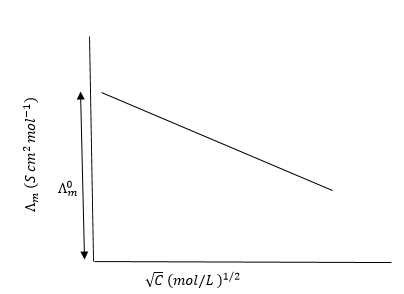
The variation of \(\Lambda _m\) with \(\sqrt{c}\) for a strong electrolyte is shown in the graph. Identify the correct representation for the same
Answer & explanation
Correct answer: option 4
The correct answer is option 4. 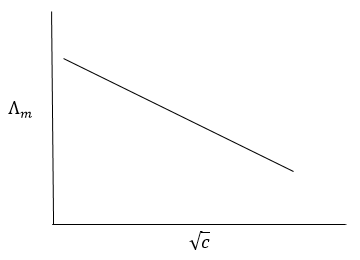
For strong electrolyte molar conductivity increases with dilution due to decrease in ion- ion force of attraction. As strong electrolytes are mostly in ionized state, no abrupt change in the number of ions with dilution. Thus, \(\Lambda _m\) increases slowly with dilution. In concentrated solution there will be a strong attraction between ions which slows down the movement of ion. On dilution of strong electrolyte, distance between the ions increases which results in decrease in ion-ion attraction. So, there will be overall increase in molar conductance of the solution.
Variation in molar conductivity of strong electrolyte due to ion-ion interaction is given by an empirical relation proposed by kohlrausch.
\(\Lambda _m = \Lambda_m^0 – A\sqrt{C}\)
\(\Lambda _m\) is the molar conductivity
\(\Lambda _m^0\) is Limiting molar conductivity
\(C\) is the concentration of electrolyte
\(A\) is constant for a given solvent and temperature
\(\Lambda _m = \Lambda_m^0 – A\sqrt{C}\)
This equation is in the form of straight line equation,
\(y = c + mx\)
So, the plot of \(\Lambda _m\) vs \(\sqrt{C}\)