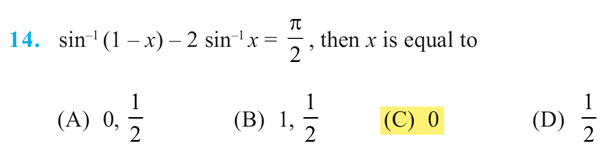
\(\sin^{-1}(1-x)-2\sin^{-1}x=\displaystyle\frac{\pi}{2}\), then x is equal to
(a) 0
(b) 1
(c) \(\displaystyle\frac{1}{2}\)
(d) 2
Choose the most appropriate answer from the options given below:
Answer & explanation
Correct answer: option 3
The correct answer is Option (3) → (a) only
Both inverse sines must be defined, so \(-1 \le x \le 1\) and \(-1 \le 1 - x \le 1\). Together these give the domain
\( 0 \le x \le 1 \)
Rearranging the equation:
\( \displaystyle \sin^{-1}(1-x) = \frac{\pi}{2} + 2\sin^{-1}x \)
The left side is at most \(\frac{\pi}{2}\) (the range of \(\sin^{-1}\)), while for \(0 \le x \le 1\) we have \(\sin^{-1}x \ge 0\). So the equation needs
\( \sin^{-1}x = 0 \)
\( x = 0 \)
Check: \(\sin^{-1}1 - 2\sin^{-1}0 = \frac{\pi}{2}\).
So x = 0 is the only solution.
Checking the statements
(a) 0 — Correct. \(\sin^{-1}1 - 0 = \frac{\pi}{2}\).
(b) 1 — Incorrect. \(\sin^{-1}0 - 2\sin^{-1}1 = -\pi\).
(c) \(\frac{1}{2}\) — Incorrect. \(\frac{\pi}{6} - \frac{\pi}{3} = -\frac{\pi}{6}\).
(d) 2 — Incorrect. \(\sin^{-1}2\) is not defined.
NCERT (2026-27 edition):
Inverse Trigonometric Functions