CUETMOCK
  • Pricing
  • Mentors
Log inStart freeStart free mocks→

First test, then trust

Try a free CUET mock test.

Join 5,00,000+ students who rehearsed exam day on the exact NTA screen before sitting CUET. On the web and on Android.

Start free mocks →Get the Android app
CUETMOCK

India's #1 CUET Mock Test Platform. Original NCERT-based questions on the exact NTA exam screen — trusted by 5,00,000+ students since CUET 2022.

Get it onGoogle PlayScan to download the CUETMOCK app

Mock tests

  • CUET mock test series
  • Browse all papers
  • Commerce mocks
  • Humanities (Arts) mocks
  • Science mocks
  • Languages & GAT mocks
  • Free practice questions
  • Pricing

Resources

  • CUET exam guide
  • CUET syllabus
  • Universities accepting CUET
  • Expert blogs
  • News & notifications
  • Webinars & counselling
  • CUET score calculator
  • How we estimate your rank
  • FAQs

Company

  • About us
  • Our leadership & team
  • Our toppers
  • Mentors
  • For schools
  • Contact us
  • Terms
  • Privacy
  • Refund policy

Talk to us

+91 7696 6630 56info@cuetmock.comWhatsApp us

Our other platforms

  • JEE Mock — For IIT-JEE aspirants
  • NEET Mock — For NEET aspirants

Newsletter

Exam updates, study material and offers — no spam.

© 2026 NYC Ventures Pvt. Ltd.

701-702, Royal Business Park, Zirakpur, Punjab - 140603

  • Terms of use
  • Privacy policy
  • Refund policy
  • Contact us

iCUETMOCK is an independent preparation platform, not affiliated with the National Testing Agency (NTA). Always check exam details on the official NTA website.

  • Home
  • Mock tests
  • CUET guide
  • Pricing
  • Log in
Home/Practice questions/History
HistoryAncient India: Kings, Farmers and Towns

Arrange the following ruling dynasties in a chronological order:(A) T…

Arrange the following ruling dynasties in a chronological order:

(A) The Shakas
(B) The Cholas, Cheras and Pandyas
(C) The Guptas
(D) The Kushanas
(E) Pushyabhutis

Choose the correct answer from the options given below:

Answer & explanation+

Correct answer: option 2

The correct answer is Option (2) → (B), (A), (D), (C), (E)

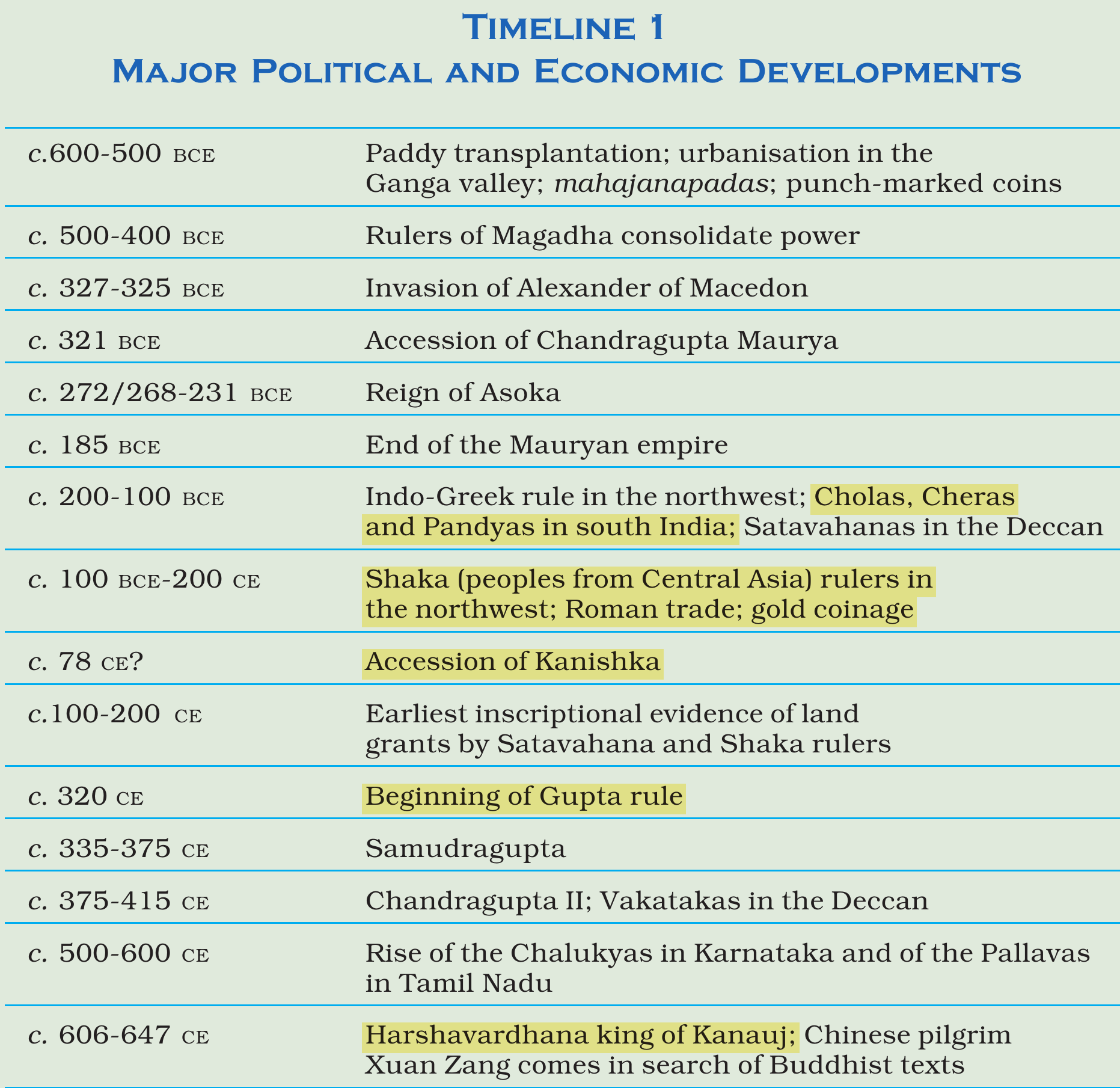
(B) The Cholas, Cheras and Pandyas — c. 200-100 BCE, rulers in south India.

(A) The Shakas — c. 100 BCE-200 CE, Shaka rulers (peoples from Central Asia) in the northwest.

(D) The Kushanas — c. 78 CE, the accession of Kanishka, the Kushana ruler.

(C) The Guptas — c. 320 CE, the beginning of Gupta rule.

(E) Pushyabhutis — c. 606-647 CE, the reign of Harshavardhana, king of Kanauj.

Note 1: The name of the Pushyabhuti dynasty is not given in the NCERT book (2026-27). Its best-known ruler was Harshavardhana, king of Kanauj (c. 606-647 CE), who is in the chapter’s timeline; this is explained here for the benefit of the students.

Note 2: The question is not properly framed, as the dates of the Shakas (c. 100 BCE-200 CE) and the Kushanas (Kanishka, c. 78 CE) overlap, and the Cholas, Cheras and Pandyas ruled in the south through the same centuries. Taken by the time at which each dynasty first appears in the chapter’s timeline, the order is (B), (A), (D), (C), (E), and only Option (2) gives this order. Therefore, Option (2) is the most appropriate answer.


NCERT: Themes in Indian History Part I — Chapter 2: Kings, Farmers and Towns (2026-27)

NCERT extract

Advertisement

Practise more on Ancient India: Kings, Farmers and Towns

Chapter-wise mocks on the real NTA exam screen, with solutions and your rank. Your first mocks are free.

Start free mocks →

Advertisement

Next questions

  1. Bhagat Singh and Chandrashekhar Azad were leading members of which revolutionary organisation, founded in Delhi in 1928?General Aptitude Test · General Knowledge
  2. Which of the following is the correct chronological order of the four Buddhist Councils?General Aptitude Test · General Knowledge
  3. Marx understood capitalism as a system of: A. Commodity production B. Production for the market C. Use of wage labour D. Money PowerSociology · Indian Society: Market as a social Institution
  4. Assertion: Morarji Desai was unsuccessful in completing 5 years as the Prime Minister of India after winning the 1977 elections.Reason: Due…Political Science · Politics in India Since Independence: Crisis of democratic Order
  5. Appearance of vegetative propagules from nodes of plant such as sugarcane and ginger is mainly because:Biology · Reproduction in Organisms
  6. What delightful sign of welcome is shown in the painting?1) Flower Garland2) Peacock Feather3) Raised Trunk of a Dark Elephant4) Incense Bu…Fine Arts · The Deccani Schools of Painting
  7. What were paintings in Rajasthani and Pahari schools painted on?Fine Arts · The Rajasthani Schools of Painting
  8. A die is thrown and a coin is tossed. The probability that the outcome will be a number greater than 4 or a head or both isApplied Maths. Section A · Probability (Section A)
  9. A solenoid of length 1.2 m and radius of 2.0 cm has 300 turns and a core of relative permeability 500. It carries a current of 3.5 A. The m…Physics · Moving Charges and Magnetism
  10. ‘You don’t close a sale, you open a relationship if you want to build a long-term, successful enterprise.’ is given by:Business Studies · Marketing