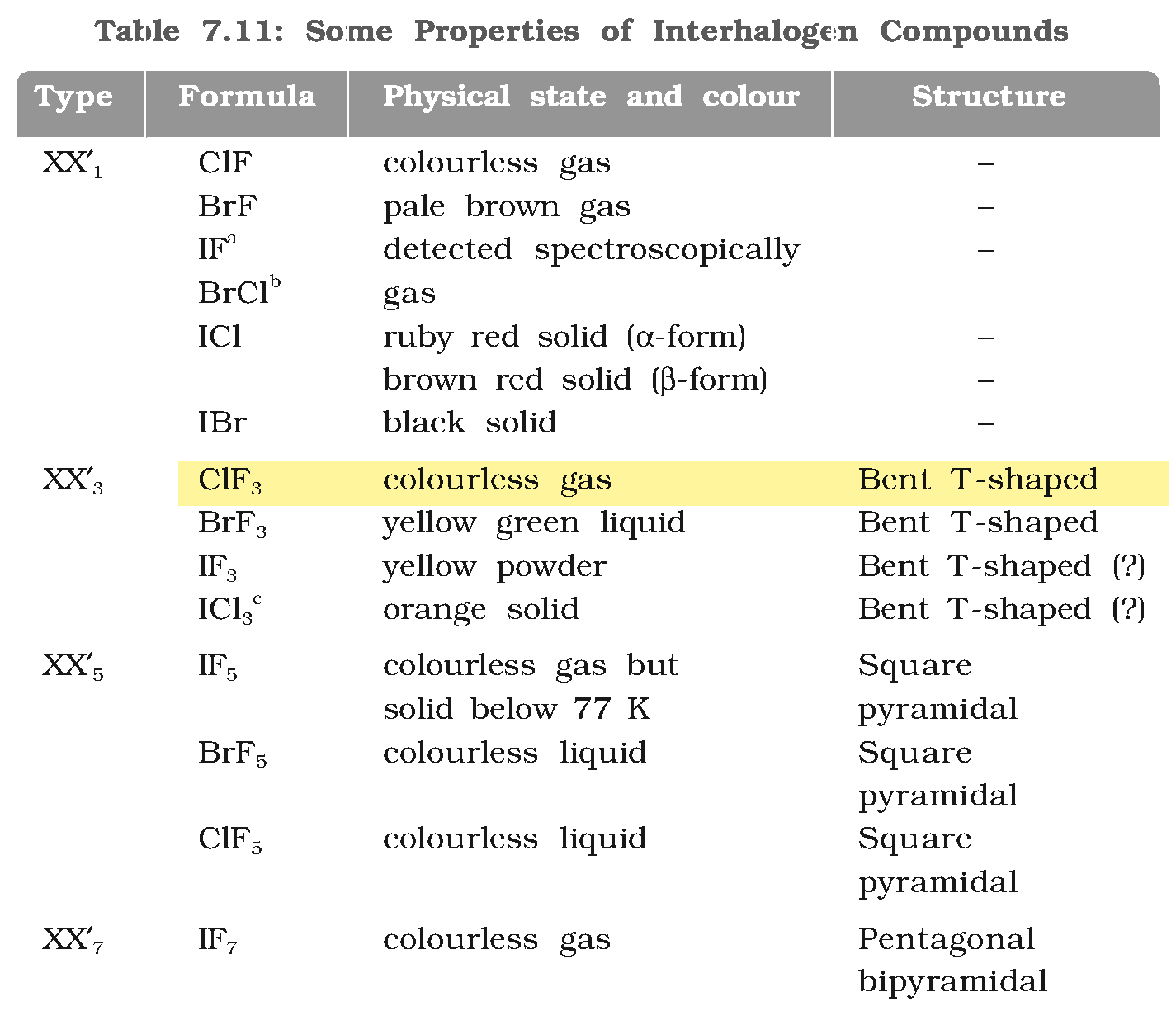
When two different halogens react with each other, interhalogen compounds are formed. They can be assigned general compositions as \(XX'\), \(XX'_3\), \(XX'_5\) and \(XX'_7\), where \(X\) is a halogen of larger size and \(X'\) of smaller size and \(X\) is more electropositive than \(X'\). As the ratio between radii of \(X\) and \(X'\) increases, the number of atoms per molecule also increases.
On the basis of above passage, answer the questions
\(ClF_3\) is ______ and ________ structure
Answer & explanation
Correct answer: option 2
The correct answer is Option (2) → Colourless gas, Bent T-shaped
\( \ce{ClF3} \) is an XX′3 interhalogen. It is a colourless gas with a bent T-shaped structure.
The shape follows from VSEPR theory: Cl has 7 valence electrons; three form bonds with F and four remain as two lone pairs:
3 bond pairs + 2 lone pairs = 5 electron pairs → trigonal bipyramidal arrangement (sp3d)
The two lone pairs occupy equatorial positions, so the three F atoms form a T, slightly bent because the lone pairs push the axial F atoms towards the equatorial one.
Why the other options are incorrect
Option (1) Coloured gas, square planar — Incorrect. \( \ce{ClF3} \) is colourless, and square planar needs four bond pairs and two lone pairs (e.g. \( \ce{ICl4^{-}} \)).
Option (3) Yellow green liquid, Bent T-shaped — Incorrect. The shape is right but the description belongs to BrF3, which is a yellow green liquid.
Option (4) Yellow powder, Trigonal Planar — Incorrect. Yellow powder is IF3, and its shape is also bent T (not trigonal planar).
Note: This question is from the pre-rationalised NCERT book (2022-23). The topic is not there in the latest NCERT book (2026-27), and it is also out of the CUET 2026 syllabus.
NCERT (Pre-rationalised edition, 2022-23):
Interhalogen Compounds – …