CUETMOCK
  • Pricing
  • Mentors
Log inStart freeStart free mocks→

First test, then trust

Try a free CUET mock test.

Join 5,00,000+ students who rehearsed exam day on the exact NTA screen before sitting CUET. On the web and on Android.

Start free mocks →Get the Android app
CUETMOCK

India's #1 CUET Mock Test Platform. Original NCERT-based questions on the exact NTA exam screen — trusted by 5,00,000+ students since CUET 2022.

Get it onGoogle PlayScan to download the CUETMOCK app

Mock tests

  • CUET mock test series
  • Browse all papers
  • Commerce mocks
  • Humanities (Arts) mocks
  • Science mocks
  • Languages & GAT mocks
  • Free practice questions
  • Pricing

Resources

  • CUET exam guide
  • CUET syllabus
  • Universities accepting CUET
  • Expert blogs
  • News & notifications
  • Webinars & counselling
  • CUET score calculator
  • How we estimate your rank
  • FAQs

Company

  • About us
  • Our leadership & team
  • Our toppers
  • Mentors
  • For schools
  • Contact us
  • Terms
  • Privacy
  • Refund policy

Talk to us

+91 7696 6630 56info@cuetmock.comWhatsApp us

Our other platforms

  • JEE Mock — For IIT-JEE aspirants
  • NEET Mock — For NEET aspirants

Newsletter

Exam updates, study material and offers — no spam.

© 2026 NYC Ventures Pvt. Ltd.

701-702, Royal Business Park, Zirakpur, Punjab - 140603

  • Terms of use
  • Privacy policy
  • Refund policy
  • Contact us

iCUETMOCK is an independent preparation platform, not affiliated with the National Testing Agency (NTA). Always check exam details on the official NTA website.

  • Home
  • Mock tests
  • CUET guide
  • Pricing
  • Log in
Home/Practice questions/General Aptitude Test
General Aptitude TestQuantitative ReasoningTrigonometry

Two poles of height 100 m and 100(√3 + 1) m stand upright on a level…

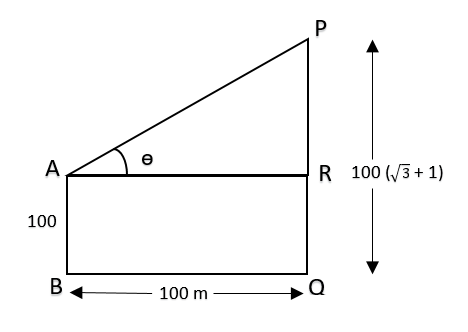
Two poles of height 100 m and 100(√3 + 1) m stand upright on a level ground 100 m apart. Find the distance between them.

Answer & explanation+

Correct answer: option 3

AB + RQ = 100 m

Therefore PR = PQ - RQ

                   = 100 (\(\sqrt {3}\) + 1) - 100 = 100 \(\sqrt {3}\) m

tan Θ = \(\frac{PR}{AR}\) = \(\frac{100 \sqrt {3}}{100}\) = \(\sqrt {3}\)

Θ = 60°

sin Θ = \(\frac{PR}{AP}\) ⇒ sin 60° = \(\frac{100 \sqrt {3}}{AP}\)

 ⇒ AP = \(\frac{100 \sqrt {3}}{sin 60°}\) = \(\frac{100 \sqrt {3}}{\sqrt {3}}\) × 2 = 200 m

Advertisement

Practise more on Quantitative Reasoning

Chapter-wise mocks on the real NTA exam screen, with solutions and your rank. Your first mocks are free.

Start free mocks →

Advertisement

Next questions

  1. With which of the following musical instruments is the musician Zakir Hussain associated?General Aptitude Test · General Knowledge
  2. Select the option that expresses the given sentence in passive voice. Sita made gulab jamuns.English · Grammar: Active Passive Voice
  3. A bar magnet of magnetic moment 3 J/T lies aligned with the directions of a uniform magnetic field of 0.2 T. The amount of work, required s…Physics · Moving Charges and Magnetism
  4. Which of the following does not release steroid hormones?Chemistry · Organic: Biomolecules
  5. दी गई पंक्तियों में कौन-सा स्थायी भाव है?"मेला उठा तो जूठे पत्तल सड़ने लगे, भिनकने लगीं मक्खियाँ; नाक दबाकर, मुँह फेरकर निकल गए राहगीर"Hindi · रस
  6. In a certain code language, ‘Fakes are not great’ is written as ‘8 6 3 2’ and ‘Tall people are great’ is written as ‘5 3 2 7’. Which one of…General Aptitude Test · Verbal Reasoning
  7. The average of 35 consecutive natural number is N. Dropping the first 10 number and including the next 10 numbers affect the average change…General Aptitude Test · Numerical Ability
  8. Babur, the first Mughal emperor, succeeded to the throne of Ferghana in 1494 when he was only ______ years old.General Aptitude Test · General Knowledge
  9. The experimental setup used for the photoelectric effect is shown. It consists of an evacuated glass/quartz tube having a thin photosensiti…Physics · Dual Nature of Radiation and Matter
  10. How did the social benefits that Indian people gained from the railways compare with the country’s economic loss under colonial rule?Economics · Indian Economic Development: Indian Economy on the Eve of Independence