
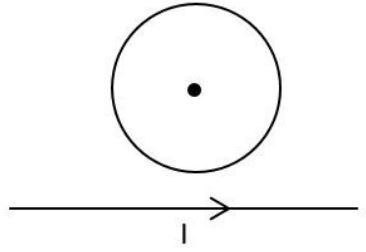
A circular loop of conducting wire is placed near a current carrying wire as shown in the figure. Both are in the same plane. If the current flowing through the wire is suddenly increased.
Answer & explanation
Correct answer: option 2
The correct answer is Option (2) → Loop will have induced current in the clockwise direction
By Lenz's law, the induced current opposes the change in magnetic flux through the loop.
By the right-hand rule, the field of the wire on the loop's side (with the current directed as shown) points out of the page. As the current increases, this outward flux increases, so the induced current must produce a field into the page inside the loop: it flows clockwise.
Option (1) Loop will have induced current in the anti-clockwise direction — Incorrect. An anticlockwise current would add to the outward flux.
Option (2) Loop will have induced current in the clockwise direction — Correct. Its field into the page opposes the increase of the outward flux.
Option (3) There will be no induced current in the loop — Incorrect. The flux through the loop changes, so a current is induced.
Option (4) the loop will be attracted by the wire — Incorrect. The near side of the loop carries current opposite to that in the wire, and antiparallel currents repel.
NCERT (2026-27):
Lenz’s Law and Conservation of Energy – “In 1834, German physicist Heinrich Friedrich Lenz (1804-1865) deduced a rule, known as Lenz’s law which gives the polarity of the induced emf in a clear and concise fashion. The statement of the law is: The polarity of induced emf is such that it tends to produce a current which opposes the change in magnetic flux that produced it.”