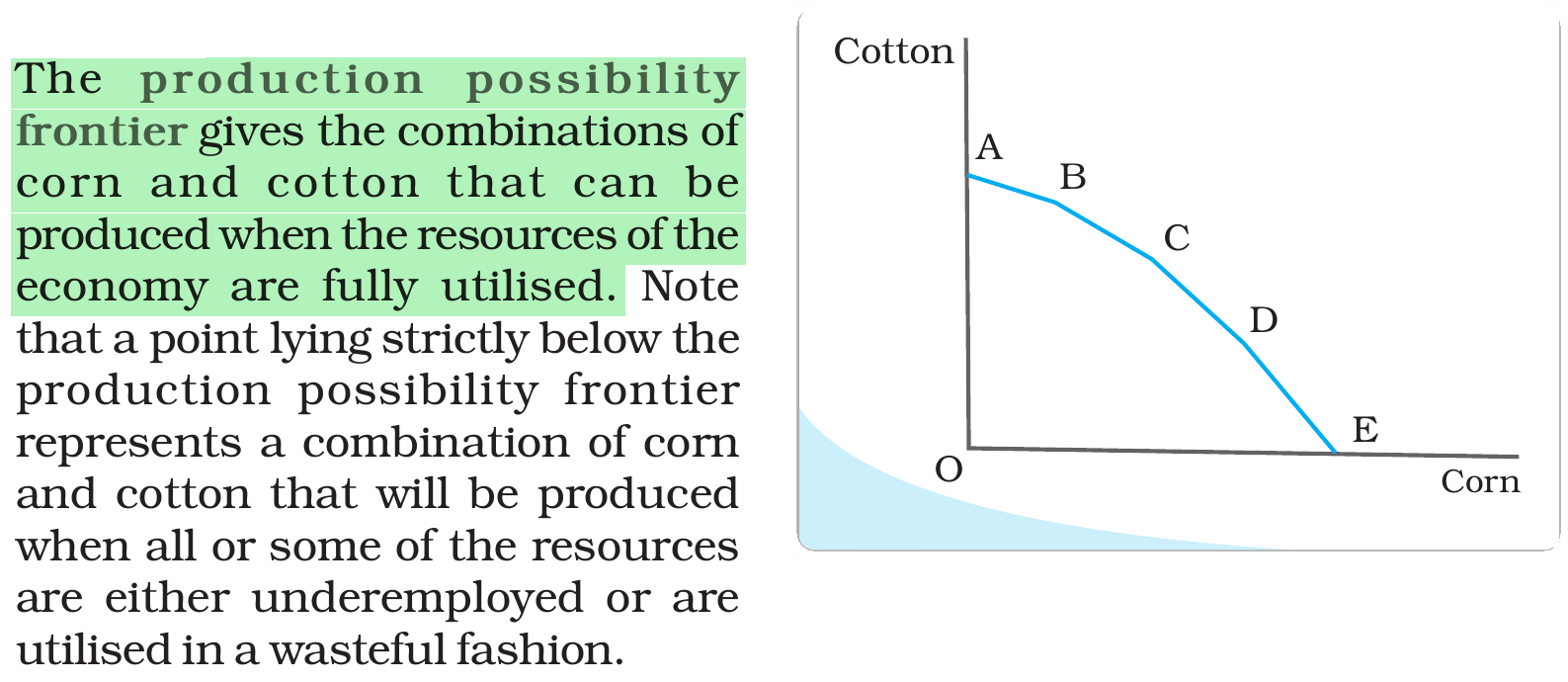
Delhi has become the most polluted city in India. Due to this, how will the production possibility curve of Delhi be affected?
Answer & explanation
Correct answer: option 1
The correct answer is Option (1) → Will shift to the left.
Severe pollution reduces the resources Delhi can use, so its production possibility curve shifts to the left.
This curve, also called the production possibility frontier, shows the combinations of goods an economy can produce when its resources are fully utilised. Pollution harms the health of workers and damages air, water and soil. With fewer usable resources, the city can produce less of every good than before.
A movement along the same curve would only mean a different mix of goods from the same resources.
Note: None of the NCERT books (2026-27, 2025-26, 2023-24 or pre-rationalised) links pollution with the production possibility frontier. The answer rests on reasoning from what the curve shows.
NCERT (2026-27): “Production Possibility Frontier … Just as individuals face scarcity of resources, the resources of an economy as a whole are always limited in comparison to what the people in the economy collectively want to have. The scarce resources have alternative usages and every society has to decide on how much of each of the resources to use in the production of different goods and services.… …An allocation of the scarce resource of the economy gives rise to a particular combination of different goods and services. Given the total amount of resources, it is possible to allocate the resources in many different ways and, thereby achieving different mixes of all possible goods and services. The collection of all possible combinations of the goods and services that can be produced from a given amount of resources and a given stock of technological knowledge is called the production possibility set of the economy.”
|