
Answer the question on the basis of passage given below:
There are three kinds of amines which are primary, secondary and tertiary amines. These amines may have alkyl group or aryl group or both alkyl and aryl groups. These amines can be distinguished from one another by various chemical tests.
An amine \(A\) on treatment with \(HNO_3\) gives \(N_2\) (g) and an alcohol \(B\). The molecular mass of alcohol \(B\) is \(46\).
Answer & explanation
Correct answer: option 2
The correct answer is option 2. \(CH_3CH_2NH_2\).
Let us analyze each option and the potential products formed upon nitration:
1. \(CH_3NH_2\) (Methylamine)
Nitration of methylamine would lead to the formation of methanol (\(CH_3OH\)) and nitrogen gas (\(N_2\)). The balanced equation for this reaction is:

The molecular mass of methanol (\(CH_3OH\)) is \(32\). This doesn't match the given molecular mass of \(46\) for alcohol \(B\).
2. \(CH_3CH_2NH_2\) (Ethylamine)
Nitration of ethylamine would result in the formation of ethanol (\(CH_3CH_2OH\)) and nitrogen gas (\(N_2\)). The balanced equation for this reaction is:

The molecular mass of ethanol (\(CH_3CH_2OH\)) is \(46\), which matches the given molecular mass for alcohol \(B\).
3. \(CH_3NHCH_3\) (Dimethylamine)
Nitration of dimethylamine would yield N-methyl-N-nitrosomethanamine \((CH_3)_2NNO\). The balanced equation for this reaction is:
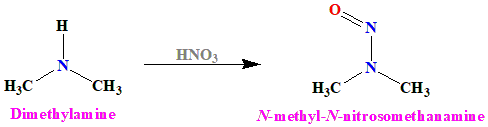
Again, the molecular mass of methanol \((CH_3)_2NNO\) is \(74\), which doesn't match the given molecular mass.
4. \((CH_3)_3N\) (Trimethylamine)
Nitration of trimethylamine would result in the formation of N,N-dimethyl-N-nitrosomethanaminium. The balanced equation for this reaction is:
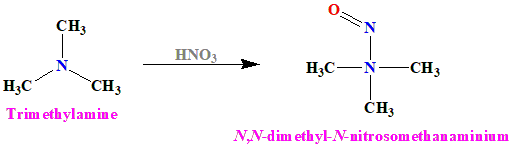
The molecular mass of \((CH_3)_3NNO\) is \(99\).
Therefore, the only option consistent with the given molecular mass of \(46\) for the alcohol (\(B\)) is \(CH_3CH_2NH_2\) (Ethylamine). Upon nitration, it forms ethanol (\(CH_3CH_2OH\)).