
A window is in the form of a rectangle surmounted by a semicircle. If the perimeter of the window is 10 m, find the dimensions of the window so that the maximum possible light is admitted.
Answer & explanation
Correct answer: option 2
The correct answer is Option (2) → Width = $\frac{20}{4+π}m$, Height of rectangle = $\frac{10}{4+π}m$
Let r metres be the radius of the semicircle and x metres be the side BC of the rectangle ABCD. Then perimeter of the window
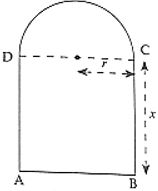
$= 2r+ 2x + πr = 10$ (given)
$⇒x=\frac{1}{2}(10-2г-πг)$ ...(i)
Maximum light will be admitted through the window if the area of the window is maximum. Let A be the area of the window,
$A=2r.x+\frac{1}{2}πг^2$
$=2r.\frac{1}{2}(10-2г-πг)+\frac{1}{2}πг^2$ (using (i))
$=10r-2r^2-\frac{1}{2}πг^2$ ...(ii)
Differentiating (ii), w.r.t. r, we get
$\frac{dA}{dr}=10-4r-πг$ and $\frac{d^2A}{dr^2}=-4-π$
Now $\frac{dA}{dr}=0⇒10-4r-πг=0⇒r=\frac{10}{4+π}$.
Also when $r=\frac{10}{4+π},\frac{d^2A}{dr^2}=-(4+π)<0$
⇒ A is maximum when $r=\frac{10}{4+π}$,
then $x=\frac{1}{2}\left(10-(2+\pi).\frac{10}{4+π}\right)=\frac{10}{4+π}$
Therefore, the maximum light is admitted when the radius of semicircle = $\frac{10}{4+π}$ metres and the side BC of the rectangle = $\frac{10}{4+π}$ metres and side AB = $\frac{20}{4+π}$ metres.