
Match Column I with Column II
|
Column I (Complex) |
Column II (Magnetic moment) |
| (A) \(K[Cr(H_2O)_2(C_2O_4)_2].3H_20\) | (p) 1.73 BM |
| (B) \(K_4[Mn(CN)_6]\) | (q) 5.92 BM |
| (C) \([Co(NH_3)_5Cl]Cl_2\) | (r) 3.87 BM |
| (D) \(Cs[FeCl_4]\) | (s) Zero |
Answer & explanation
Correct answer: option 1
The correct answer is option 1. A-r, B-p, C-s, D-q
A. The given complex is \(K[Cr(H_2O)_2(C_2O_4)_2].3H_20\)
Let the oxidation number of \(Cr\) be \(x\)
\(∴ 1 + x + 2 × 0 + 2(−2) = 0\)
\(⇒ x = 3\)
So, the electronic configuration of Cr in +3 oxidation state is
\(Cr^{3+} = _{18}Ar] 4s^0 3d^3\)
Here, the number of unpaired electrons, \(n = 3\)
Therefore, the magnetic moment is
\(\mu = \sqrt{3(3 + 2)} = 3.87 BM\) i.e., (r)
B. The given complex is \(K_4[Mn(CN)_6]\)
Let the oxidation number of \(Mn\) be \(x\)
\(∴ 4 + x + 6 × (−1) = 0\)
\(⇒ x = 2\)
So, the electronic configuration of Mn in +2 oxidation state is
\(Mn^{2+} = _{18}Ar] 4s^0 3d^5\)
But due to the presence of a strong field ligand pairing of the electrons occurs and so the d-orbital can be presented as
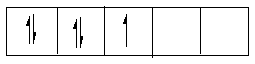
Here, the number of unpaired electrons, \(n = 1\)
Therefore, the magnetic moment is
\(\mu = \sqrt{1(1 + 2)} = 1.73 BM\) i.e., (p)
C. The given complex is \([Co(NH_3)_5Cl]Cl_2\)
Let the oxidation number of \(Co\) be \(x\)
\(∴ x + 3 × 0 + (−1) + (−2)= 0\)
\(⇒ x = 3\)
So, the electronic configuration of Co in +3 oxidation state is
\(Co^{3+} = _{18}Ar] 4s^0 3d^6\)
But due to the presence of the strong field ligand pairing of electrons occurs in the d-orbital in the \(t_{2g}\) level
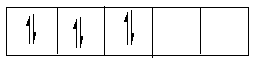
So, the number of unpaired electrons, \(n = 0\) [ due to pairing]
Therefore, the magnetic moment is
\(\mu = \sqrt{0(0 + 2)} = 0 BM\) i.e., (s)
D. The given complex is \(Cs[FeCl_4]\)
Let the oxidation number of \(Fe\) be \(x\)
\(∴ 1 + x + 4 × (−1) = 0\)
\(⇒ x = 3\)
So, the electronic configuration of Fe in +3 oxidation state is
\(Fe^{3+} = _{18}Ar] 4s^0 3d^5\)
Here, the number of unpaired electrons, \(n = 5\)
Therefore, the magnetic moment is
\(\mu = \sqrt{5(5 + 2)} = 5.92 BM\) i.e., (q)
The correct answer is (a) A-r, B-p, C-s, D-q