
Match List I with List II
|
LIST I |
LIST II |
| A. Phenol | I. Lucas Test |
| B. Ethers | II. Reimer Tiemann Reaction |
| C. Alcohol | III. Williamson's Synthesis |
| D. 2,4,6-trinitrophenol | IV. Picric acid |
Choose the correct answer from the options given below:
Answer & explanation
Correct answer: option 4
The correct answer is option 4. A-II, B-III, C-I, D-IV.
|
LIST I |
LIST II |
| A. Phenol | II. Reimer Tiemann Reaction |
| B. Ethers | III. Williamson's Synthesis |
| C. Alcohol | IV. Picric acid |
| D. 2,4,6-trinitrophenol | I. Lucas Test |
A. Phenol: II. Reimer-Teimann Reaction:
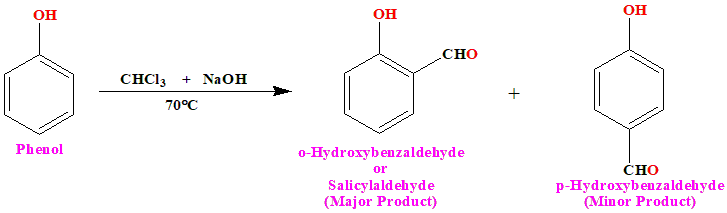
Reimer Tiemann reaction is a type of substitution reaction named after chemists Karl Reimer and Ferdinand Tiemann. The reaction is used for the ortho-formylation of \(C_6H_5OH\) (phenols). When phenol, i.e. \(C_6H_5OH\), is treated with \(CHCl_3\) (chloroform) in the presence of \(NaOH\) (sodium hydroxide), an aldehyde group \((-CHO)\) is introduced at the ortho position of the benzene ring leading to the formation of o-hydroxybenzaldehyde. The reaction is popularly known as the Reimer Tiemann reaction.
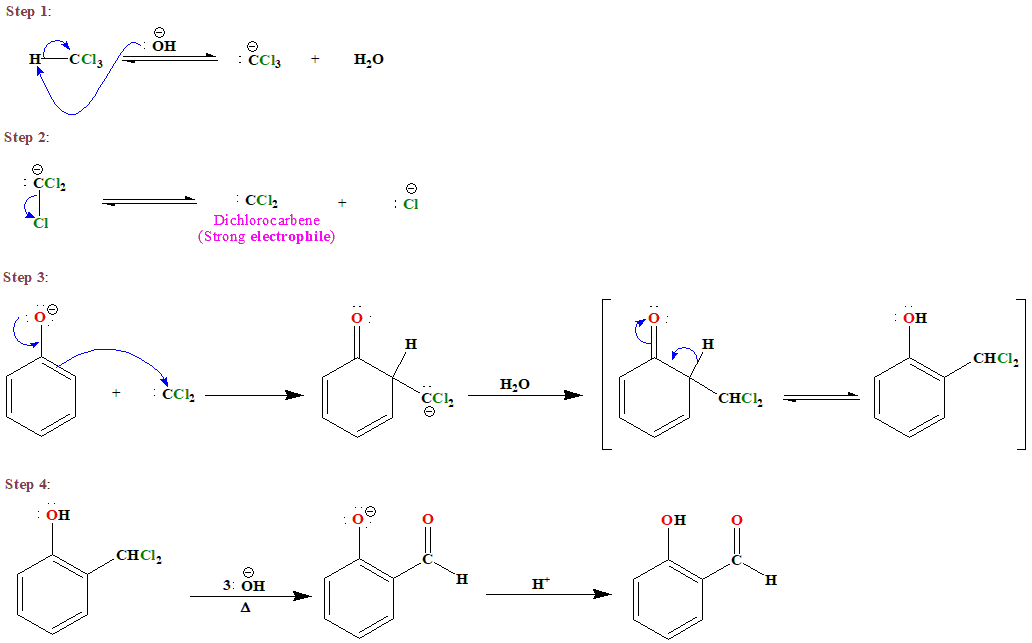
Mechanism: It involves electrophilic substitution of the aromatic nucleus, the electrophile being dichlororcarbene, formed by the action of strong alkali on chloroform.
B. Ether: Williamson's Synthesis:
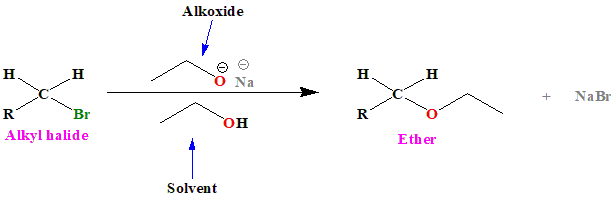
In the Williamson Ether Synthesis, an alkyl halide (or sulfonate, such as a tosylate or mesylate) undergoes nucleophilic substitution \((S_N2)\) by an alkoxide to give an ether.
Being an \(S_N2\) reaction, best results are obtained with primary alkyl halides or methyl halides. Tertiary alkyl halides give elimination instead of ethers. Secondary alkyl halides will give a mixture of elimination and substitution.
The alkoxide \(RO^-\) can be those of methyl, primary, secondary, or tertiary alcohols.
The reaction is often run with a mixture of the alkoxide and its parent alcohol (e.g. \(NaOEt/EtOH\) or \(CH_3ONa/CH_3OH\)). Alternatively, a strong base may be added to the alcohol to give the alkoxide. Sodium hydride \((NaH)\) or potassium hydride \((KH)\) are popular choices.
When an alkoxide and alkyl halide are present on the same molecule, an intramolecular reaction may result to give a new ring. This works best for 5- and 6-membered rings.
When planning the synthesis of ethers using the Williamson, take care to select the best starting materials for an \(S_N2\) reaction.
Mechanism:

C. Alcohol: I. Lucas Test:
Lucas Test: The chemical method used for distinguishing between primary, secondary and tertiary alcohol is known as the Lucas test. In the Lucas test, a solution of anhydrous zinc chloride in concentrated hydrochloric acid is used to differentiate between the three categories of alcohols i.e. primary, secondary and tertiary alcohol. The solution of anhydrous zinc chloride in concentrated hydrochloric acid is known as Lucas reagent. Primary, secondary and tertiary alcohol reacts with the Lucas reagent very differently and gives a wide range of results, which is the foundation of the Lucas test.
The Lucas test is a very good reaction to determine and describe the reactivity of different types of alcohol. For instance primary alcohol does not readily react with the Lucas reagent at room temperature whereas tertiary alcohols immediately react with the Lucas reagent at room temperature. The reactivity is measured by the degree of turbidity of the solution, which varies from colourless to turbid.
The Lucas reaction follows the mechanism of nucleophilic substitution reaction. In this reaction, the carbocation of alcohol is formed as an intermediate. The reaction mechanism followed in this reaction is unimolecular nucleophilic substitution reaction.
Lucas Test for Primary Alcohols
When the Lucas reagent is added to primary alcohol, there is no change observed in the solution, rather it remains colourless. The solution is then heated for about 30-45 minutes and an oily layer is formed in the solution.
For example- \(C_2H_5OH + HCl\longrightarrow C_2H_5Cl + H_2O\)
In this reaction no turbidity is observed.
Lucas Test for Secondary Alcohols
In addition to the Lucas reagent in the solution containing secondary alcohol, an oily layer is formed in three to five minutes and turbidity is observed in the solution. The time required to form an oily layer varies on the basis of solubility.
For example- \((CH_3)_2CHOH + HCl + ZnCl_2 \longrightarrow (CH_3)_2CHCl + H_2O + ZnCl_2\)
There is formation of propyl chloride, which is responsible for the turbidity in the solution.
Lucas Test for Tertiary Alcohols
Tertiary alcohols on reaction with the Lucas reagent quickly form an oily layer and turbidity is also observed immediately in the solution.
For example- \((CH_3)_3CHOH + HCl + ZnCl_2 \longrightarrow (CH_3)_3CHCl + H_2O + ZnCl_2\)
D. 2,4,6-Trinitrophenol: IV. Picric acid:
The compound 2,4,6-trinitrophenol, commonly known as picric acid, is named as such due to historical reasons rather than its actual acidic properties. Picric acid is an organic compound with the chemical formula \(C_6H_2(NO_2)_3OH\). It is a powerful explosive and was historically used as a yellow dye and as an antiseptic.
Although picric acid does not contain a carboxylic acid group \((-COOH)\), which is characteristic of most compounds referred to as acids, it does have phenolic hydroxyl groups \((-OH)\) that can exhibit weak acidic properties. The phenolic hydroxyl groups can release hydrogen ions (protons) in solution, leading to a slightly acidic behavior. These phenolic hydroxyl groups are responsible for the weakly acidic properties of picric acid, which can react with bases to form salts.
The name "picric acid" likely originated from the Greek word "pikros," meaning bitter, which refers to the compound's bitter taste. Over time, the name "picric acid" has remained in use despite the compound's lack of a carboxylic acid group. It is important to note that while picric acid can exhibit acidic properties, it is not a strong acid like sulfuric acid or hydrochloric acid.