
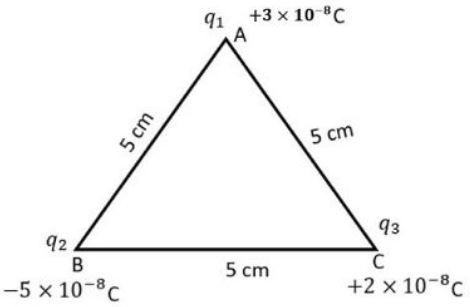
Three point charges are placed at the corners of an equilateral triangle ABC as shown. The work done to put together these charges from infinity to their respective locations is
Answer & explanation
Correct answer: option 3
The correct answer is Option (3) → $-3.42 × 10^{-4}J$
Given charges at corners of an equilateral triangle of side $r=5\ \text{cm}=0.05\ \text{m}$:
$q_1=+3\times10^{-8}\ \text{C},\; q_2=-5\times10^{-8}\ \text{C},\; q_3=+2\times10^{-8}\ \text{C}$
Electrostatic potential energy (work to assemble) :
$U = \frac{1}{4\pi\epsilon_0}\left(\frac{q_1q_2}{r}+\frac{q_1q_3}{r}+\frac{q_2q_3}{r}\right)$
Compute pair products and sum:
$q_1q_2=-1.5\times10^{-15}\ \text{C}^2,\; q_1q_3=0.6\times10^{-15}\ \text{C}^2,\; q_2q_3=-1.0\times10^{-15}\ \text{C}^2$
Sum $= -1.9\times10^{-15}\ \text{C}^2$
Using $\frac{1}{4\pi\epsilon_0}=9\times10^{9}\ \text{N·m}^2\text{·C}^{-2}$:
$U = 9\times10^{9}\times\frac{-1.9\times10^{-15}}{0.05} = -3.42\times10^{-4}\ \text{J}$
Answer: $-3.42\times10^{-4}\ \text{J}$