


CUET Preparation Today
Match List-I with List II.
Choose the correct answer from the options given below: |
(A)-(IV), (B)-(I), (C)-(II), (D)-(III) (A)-(II), (B)-(III), (C)-(IV), (D)-(I) (A)-(I), (B)-(III), (C)-(IV), (D)-(II) (A)-(I), (B)-(III), (C)-(II), (D)-(IV) |
(A)-(I), (B)-(III), (C)-(IV), (D)-(II) |
The correct answer is Option (3) → (A)-(I), (B)-(III), (C)-(IV), (D)-(II)
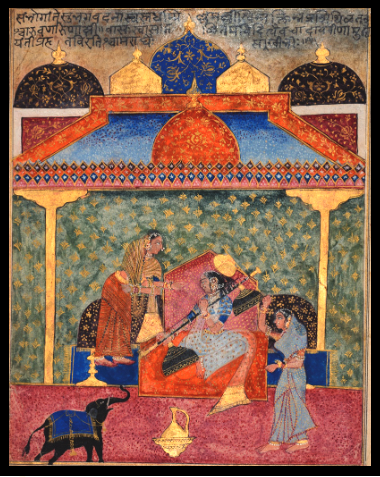
Ragini Pathamsika: An intriguing work in the collection of National Museum, New Delhi, titled Ragini Pathamsika of Raga Hindola, an important member of the Ragamala family of the Indian musical mode, dates back to around 1590–95. Some scholars believe it to be from Bijapur, an important state of Deccan. Painting was a highly developed art form in the Deccani states, almost simultaneous with the development of the Mughal School of Painting. Persian influence is obvious in the painting. This is seen in the arabesque decoration on the surface of the two domes that delineate the upper part of the painting, where letters written in Devanagari script cover the space. Two beautifully dressed and bejewelled women are seen in the pavilion, while the third is seen outside it. The centrally placed female musician is playing an Indian instrument, which appears to be veena, while the other two on the sides appear to be accompanying with rhythmic sway of their bodies. The colours are vibrant. Red is dominant and is complimented by green. The figures may be said to be stylised in the sense that the character of their physiology, including the face has been almost constructed on formulaic details.
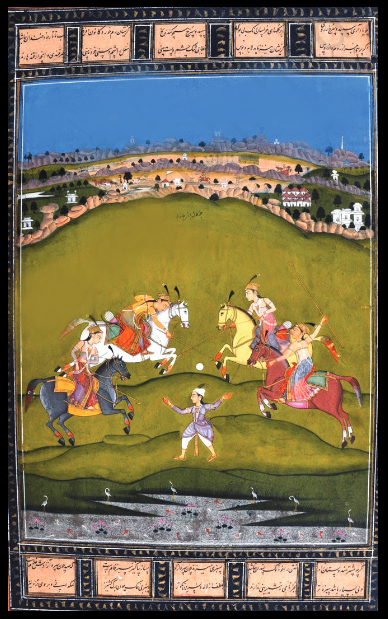
Chand Bibi playing polo: This painting shows Chand Bibi, the Queen of Bijapur, one of the most prosperous and culturally refined Deccani state. Chand Bibi resisted the Mughal political attempts to overtake the state by Emperor Akbar. A revered and accomplished ruler, Chand Bibi was a great sportsperson. Here, she is showing playing chaugan, the other name for equestrian polo game, a popular royal sport of the time. The painting appears to be provincial of much later period, and is in the collection of National Museum, New Delhi, India. In it the players mounted on white and yellow horses and trying to control the ball with sticks.
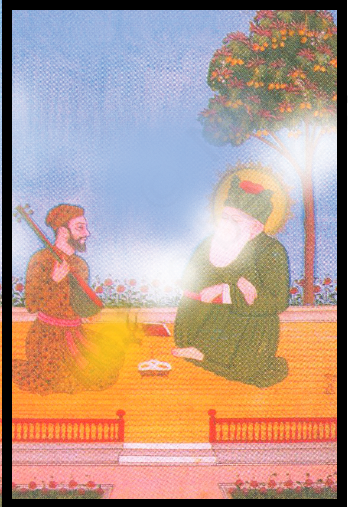
Hazrat Nizamuddin Auliya and Amir Khusro: This provincial painting in the collection of National Museum, New Delhi, is from Hyderabad, Deccan. It depicts Hazrat Nizamuddin Auliya, the revered Sufi saint of the thirteenth century, listening to music being played by his disciple, Hazrat Amir Khusrau, a renowned Indian poet and scholar. Even to this day, the dargah of Hazrat Nizamudin Auliya in New Delhi has qawwali by Khusrau in praise of his pir. Devotees from all over the world come here to witness this regular cultural practice. The painting is naive and basic without technical and artistic sophistication of a court painting. However, it is charming and narrative of a popular Indian theme. This miniature has been painted with preference of romantic elements, in which two human figures are shown sitting on a platform. |