


CUET Preparation Today
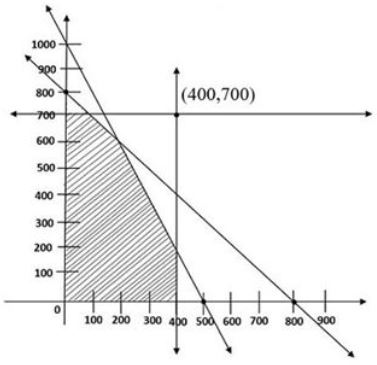
Which one of the following set of constraints represents the shaded region given below?
|
$x + y ≤ 800, 2x + y ≤ 1000, x ≤ 400, y ≤ 700,x ≥ 0,y ≥ 0$ $x + y≥ 800, 2x + y ≤ 1000, x ≤ 400, y ≥700,x ≥ 0, y ≥ 0$ $x + y ≤ 800, 2x + y ≥ 1000, x ≥ 400, y ≤ 700, x, y ≥0$ $x + y ≥ 800, 2x + y ≥ 1000, x ≤ 400, y ≤ 700,x ≥ 0,y ≥ 0$ |
$x + y ≤ 800, 2x + y ≤ 1000, x ≤ 400, y ≤ 700,x ≥ 0,y ≥ 0$ |
The correct answer is Option (1) → $x + y ≤ 800, 2x + y ≤ 1000, x ≤ 400, y ≤ 700,x ≥ 0,y ≥ 0$ To find the system of inequalities representing the shaded region, observe the boundaries and intercepts of the lines: 1. The line passing through (800, 0) and (0, 800) has the equation: $x + y = 800 \Rightarrow x + y \leq 800$ (since region is below this line) 2. The line passing through (500, 0) and (0, 1000) has the equation: $2x + y = 1000 \Rightarrow 2x + y \leq 1000$ (since region is below this line) 3. The vertical boundary at $x = 400$ gives: $x \leq 400$ 4. The horizontal boundary at $y = 700$ gives: $y \leq 700$ 5. Since only the first quadrant is considered: $x \geq 0$ and $y \geq 0$ |