
The side of an equilateral ΔABC is $3\sqrt{7}$ cm. P is a point on side BC such that BP : PC = 1 : 2. The length (in cm) of AP is:
Answer & explanation
Correct answer: option 2
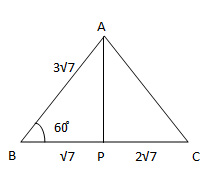
\(\angle\)ABC = \({60}^\circ\) (angle of an equilateral triangle)
Now, according to the question,
BC = BP : PC = 1 : 2
BP = \(\frac{1 \;×\; 3√ 7}{3}\) = \(\sqrt {7 }\)
PC = \(\frac{2 \;×\; 3√ 7}{3}\) = 2\(\sqrt {7 }\)
Now,
Apply cosine rule on triangle APB
= cos 60 = (\( {b }^{2 } \) + \( {c }^{2 } \) - \( {a }^{2 } \))/2bc
= \(\frac{1}{2}\) = (\( {(3√7)}^{2 } \) + \( {√7}^{2 } \) - \( {AP}^{2 } \))/(2 x 3√7 x √7)
= \(\frac{1}{2}\) = [(63 + 7) - \( {AP}^{2 } \)]/42
= \(\frac{1}{2}\) = [70 - \( {AP}^{2 } \)]/42
= \( {AP}^{2 } \) = 70 - 21
= \( {AP}^{2 } \) = 49
= AP = 7
Therefore, AP is 7.