Match List – I with List – II.
|
LIST I |
LIST II |
|
A. Atlas 66 |
I. Rice |
|
B. Spirulina |
II. Okra |
|
C. IR – 8 |
III. Wheat |
|
D. Pusa sawani |
IV. Single Cell Protein |
Choose the correct answer from the options given below:
Answer & explanation
Correct answer: option 4
The correct answer is Option (4) →A-III, B-IV, C-I, D-II
|
LIST I |
LIST II |
|
A. Atlas 66 |
III. Wheat |
|
B. Spirulina |
IV. Single Cell Protein |
|
C. IR – 8 |
I. Rice |
|
D. Pusa sawani |
II. Okra |
A. Wheat variety, Atlas 66, having a high protein content, has been used as a donor for improving cultivated wheat.
B. One of the alternate sources of proteins for animal and human nutrition is Single Cell Protein (SCP). Microbes are being grown on an industrial scale as source of good protein. Microbes like Spirulina can be grown easily on materials like waste water from potato processing plants (containing starch), straw, molasses, animal manure and even sewage, to produce large quantities and can serve as food rich in protein, minerals, fats, carbohydrate and vitamins. Incidentally such utilisation also reduces environmental pollution.
C. India is mainly an agricultural country. Agriculture accounts for approximately 33 per cent of India’s GDP and employs nearly 62 per cent of the population. Semi-dwarf rice varieties were derived from IR-8, (developed at International Rice Research Institute (IRRI), Philippines) and Taichung Native-1 (from Taiwan). The derivatives were introduced in 1966. Later better-yielding semi- dwarf varieties Jaya and Ratna were developed in India.
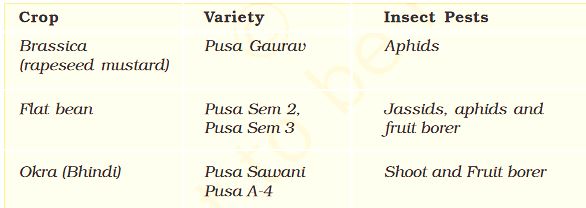
D. Pusa sawani is the disease resistant variety of okra and is resistant to shoot and fruit borer.