
Observe the figure and answer the following questions:
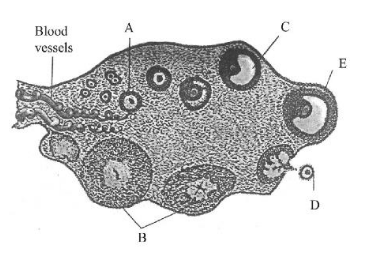
Different stages of oogenesis are given below. Arrange them in the sequence of their occurrence:
A. Completion of first meiotic division of primary oocyte
B. Release of ovum from the ovary.
C. Primary oocyte in the primary follicle formation.
D. Graafian follicle
Choose the correct answer from the options given below:
Answer & explanation
Correct answer: option 3
The correct answer is Option (3) → C, A, D, B
The process of formation of a mature female gamete is called oogenesis. Oogenesis is initiated during the embryonic development stage when a couple of million gamete mother cells (oogonia) are formed within each fetal ovary; no more oogonia are formed and added after birth. These cells start division and enter into prophase-I of the meiotic division and get temporarily arrested at that stage, called primary oocytes. Each primary oocyte then gets surrounded by a layer of granulosa cells and is called the primary follicle . A large number of these follicles degenerate during the phase from birth to puberty. Therefore, at puberty only 60,000-80,000 primary follicles are left in each ovary. The primary follicles get surrounded by more layers of granulosa cells and a new theca and are called secondary follicles.
The secondary follicle soon transforms into a tertiary follicle which is characterised by a fluid filled cavity called antrum. The theca layer is organised into an inner theca interna and an outer theca externa. At this stage that the primary oocyte within the tertiary follicle grows in size and completes its first meiotic division. It is an unequal division resulting in the formation of a large haploid secondary oocyte and a tiny first polar body. The secondary oocyte retains bulk of the nutrient rich cytoplasm of the primary oocyte. The tertiary follicle further changes into the mature follicle or Graafian follicle. The secondary oocyte forms a new membrane called zona pellucida surrounding it. The Graafian follicle now ruptures to release the secondary oocyte (ovum) from the ovary by the process called ovulation.
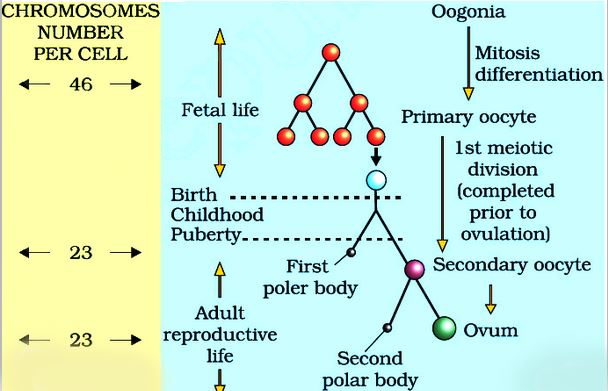
Oogenesis