Select the correct statements for \( [Fe(CN)_6]^{3-} \) complex:
(A) Paramagnetic
(B) \( sp^3d^2 \) hybridization
(C) Magnetic moment = 5.92 BM
(D) \( d^2sp^3 \) hybridization
Choose the correct answer from the options given below:
Answer & explanation
Correct answer: option 1
The correct answer is Option (1) → (A) and (D) only
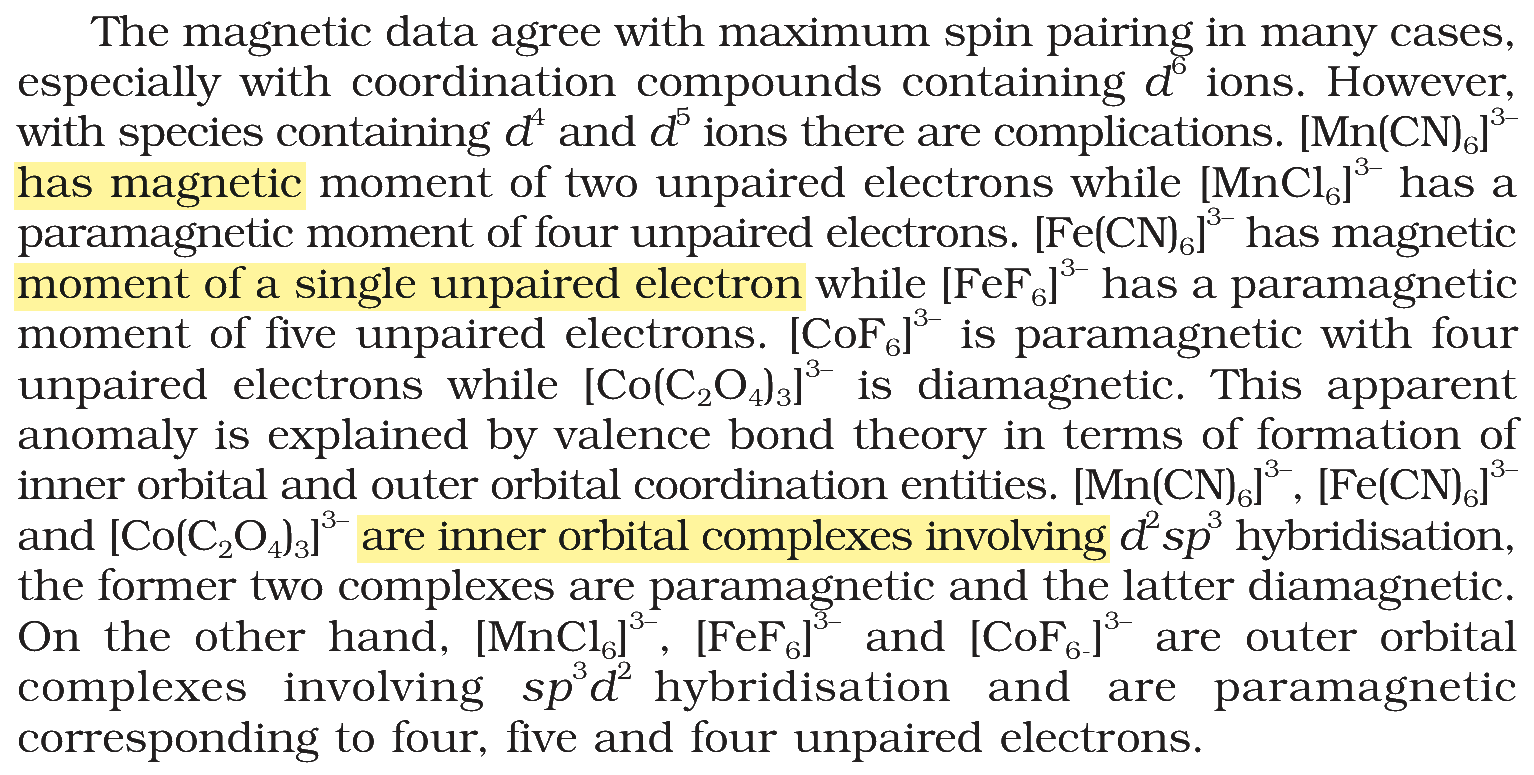
In \( \ce{[Fe(CN)6]^3-} \) the oxidation state of iron follows from the charges: x + 6(−1) = −3, so x = +3. Fe (Z = 26) is \( \mathrm{[Ar]\,3d^{6}\,4s^{2}} \); losing the two 4s electrons and one 3d electron gives \( \ce{Fe^3+} \): \( \mathrm{3d^{5}} \).
\( \ce{CN-} \) is a strong field ligand, so it forces the five 3d electrons to pair up into three orbitals: two pairs and one unpaired electron. Two 3d orbitals are left empty, and they hybridise with the 4s and three 4p orbitals to give \( \mathrm{d^{2}sp^{3}} \) hybridisation (an inner orbital, low spin, octahedral complex).
\( \displaystyle \mu = \sqrt{n(n+2)} = \sqrt{1 \times 3} \approx 1.73\ \mathrm{BM} \)
(A) Paramagnetic — Correct. One unpaired electron makes it paramagnetic.
(B) \( \mathrm{sp^{3}d^{2}} \) hybridization — Incorrect. Outer orbital \( \mathrm{sp^{3}d^{2}} \) hybridisation occurs with weak field ligands, as in \( \ce{[FeF6]^3-} \).
(C) Magnetic moment = 5.92 BM — Incorrect. 5.92 BM corresponds to five unpaired electrons (\( \sqrt{35} \)), the high spin \( \ce{[FeF6]^3-} \); here the value is about 1.73 BM.
(D) \( \mathrm{d^{2}sp^{3}} \) hybridization — Correct. The two vacant inner 3d orbitals are used.
NCERT (2026-27 edition):
Magnetic Properties of Coordination Compounds – …