
Consider the LPP, Max Z= 2x + y, subject to the conditions
$3x+2y ≤ 6$
$4x+y ≤ 4 $
$x ≥ 0, y ≥0,$ then the maximum value of the objective function is :
Answer & explanation
Correct answer: option 2
The correct answer is Option (2) → $\frac{16}{5}$
$3x+2y ≤ 6⇒\frac{x}{2}+\frac{y}{3}≤ 6$
$4x+y ≤ 4⇒\frac{x}{1}+\frac{y}{4}≤1$
$x, y ≥0$ ⇒ first quadrant
finding intersection
$3x+2y=6$ ...(1)
$4x+y=4$ ...(2)
Eq. (2) × 2 - Eq. (1)
$8x+6y-3x-2y=8-6$
$5x=2$
$⇒x=\frac{2}{5}$
from (2) $\frac{8}{5}+y=4$
so $y=\frac{12}{5}$
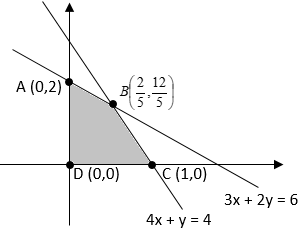
| corner points | $Z=2x+y$ |
| $A(0,,2)$ | $Z_A=2$ |
| $B(\frac{2}{5},\frac{12}{5})$ | $Z_B=\frac{16}{5}$ |
| $C(1,0)$ | $Z_C=2$ |
| $D(0,0)$ | $Z_D=0$ |
Maximum value → $Z_B=\frac{16}{5}$