
Out of the following given statements, the incorrect statements are;
(A) 2, 2, 6-Trimethylcyclohexanone forms a cyanohydrin in good yield, but the cyclohexanone doesn't.
(B) There are two amino groups in semicarbazide and both can be involved in the formation of semicarbazones.
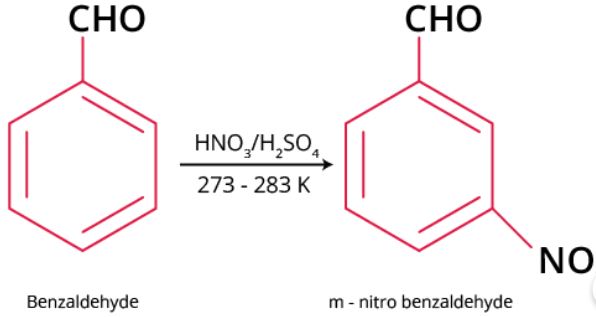
(C) Mononitration of benzaldehyde will form m-nitrobenzaldehyde.
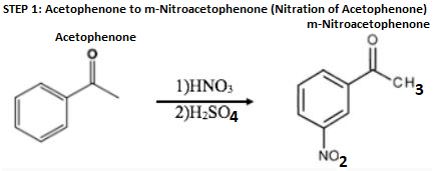
(D) Mononitration of acetophenone will form m-nitroacetophenone.
Choose the correct answer from the options given below:
Answer & explanation
Correct answer: option 4
The correct answer is Option (4) → (A), (B) and (D) only
We evaluate each statement based on:
- Steric hindrance in nucleophilic addition
- Reactivity of functional groups
- Directing effects in electrophilic substitution
- Structure of semicarbazide
Option-wise Explanation
Option A
2,2,6-Trimethylcyclohexanone is sterically hindered.
Bulky methyl groups reduce accessibility of carbonyl carbon.
This decreases nucleophilic addition like cyanohydrin formation.
Cyclohexanone, being less hindered, forms cyanohydrin more easily.
Thus, statement is incorrect.
Option B
Semicarbazide has structure:
$\text{NH}_2-\text{NH}-\text{CO}-\text{NH}_2$
Only one amino group ($-\text{NH}_2$ attached to $-\text{NH}-$) participates in semicarbazone formation.
The amide $-\text{NH}_2$ is not reactive due to resonance.
Thus, both amino groups are not involved.
Statement is incorrect.
Option C
$-\text{CHO}$ group is electron withdrawing.
It shows $-M$ and $-I$ effect.
Directs electrophilic substitution to meta position.
Thus, nitration gives $m$-nitrobenzaldehyde.
Statement is correct.
Option D
$-\text{COCH}_3$ group is also electron withdrawing.
Shows $-M$ effect.
Meta directing.
Thus, nitration gives $m$-nitroacetophenone.
Statement is correct.
Note: According to us 3 and 4 are correct statements, and the incorrect ones are statements 1 and 2. But there is no option for this. The answer is marked as according to NTA answer sheet.