Match List-I with List-II.
List-I Picture/Style | List-II Place |
(A) Pichhwais | (I) Bhilwara |
(B) Bani - Thani | (II) Nathdwara |
(C) Pabuji's Phad | (III) Jodhpur |
(D) Dhola and Maru | (IV) Kishangarh |
Choose the correct answer from the options given below:
Answer & explanation
Correct answer: option 2
The correct answer is Option (2) → (A) - (II), (B) - (IV), (C) - (I), (D) - (III)
| List-I | List-II | Reason |
|---|---|---|
| (A) Pichhwais | (II) Nathdwara | At Nathdwara, these large backdrops were painted on cloth for the deity Shrinathji. |
| (B) Bani - Thani | (IV) Kishangarh | The typical Kishangarh face is believed to come from the features of Bani Thani. |
| (C) Pabuji’s Phad | (I) Bhilwara | Phads honour the folk deities of pastoral communities around Bhilwara. |
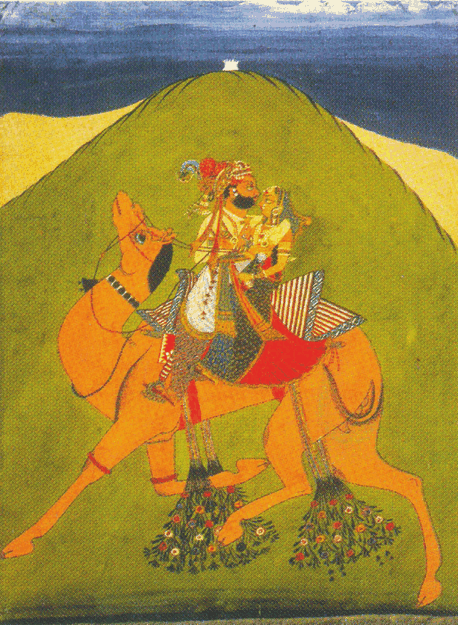
| (D) Dhola and Maru | (III) Jodhpur | This painting of 1810 belongs to the Jodhpur School. |
NCERT (2026-27): “Mewar School of Painting …Nathdwara, a town close to Udaipur and a prominent Vaishnava centre, also emerged as a school of painting in the late seventeenth century. Large backdrops called pichhwais were painted on cloth for the deity, Shrinathji, for several festive occasions.…” “Bani Thani …The exaggerated facial type of Kishangarh, which becomes the distinctive and salient stylistic feature of the Kishangarh School, is believed to have been derived from the attractively sharp facial features of Bani Thani.…” “Phads of Rajasthan Phads are long, horizontal, cloth scrolls painted to honour folk deities of pastoral communities inhabiting the region around Bhilwara in Rajasthan.…”
Dhola and Maru, Jodhpur, 1810, National Museum, New Delhi |