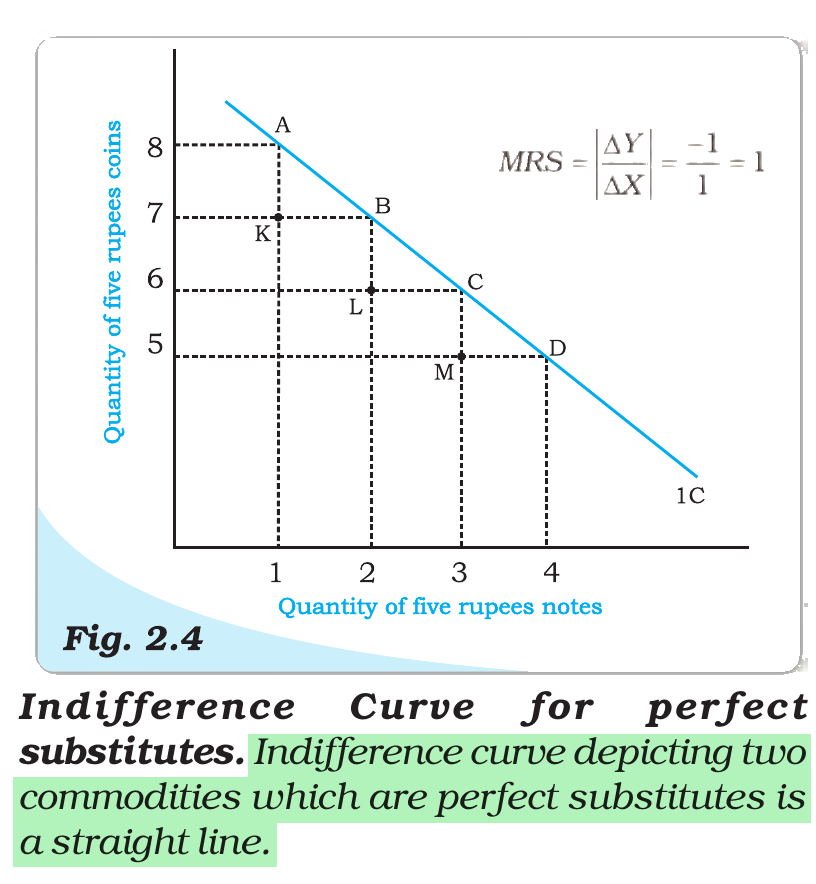
When two commodities are perfect substitutes for the consumer, the indifference curve will be _________ .
Fill in the blank with suitable answer from below:
Answer & explanation
Correct answer: option 4
The correct answer is Option (4) → Straight line
An indifference curve joins the bundles of two goods that give the consumer the same satisfaction. Perfect substitutes are goods that can be used in place of each other and give the same satisfaction. A five-rupee coin and a five-rupee note are an example.
With such goods, the consumer gives up the same amount of one good each time she gets one more unit of the other. The rate stays the same all along the curve, so the curve is a straight line.
In the usual case the curve is convex to the origin. There the consumer gives up less and less of one good for each extra unit of the other.
NCERT (2026-27): “Shape of an Indifference Curve It may be mentioned that the law of Diminishing Marginal Rate of Substitution causes an indifference curve to be convex to the origin. This is the most common shape of an indifference curve. But in case of goods being perfect substitutes4, the marginal rate of substitution does not diminish. It remains the same.… …For the consumer, it hardly matters whether she gets a five rupee coin or a five rupee note. So, irrespective of how many five rupee notes she has, the consumer will sacrifice only one five rupee coin for a five rupee note. So these two commodities are perfect substitutes for the consumer and indifference curve depicting these will be a straight line.”
|