
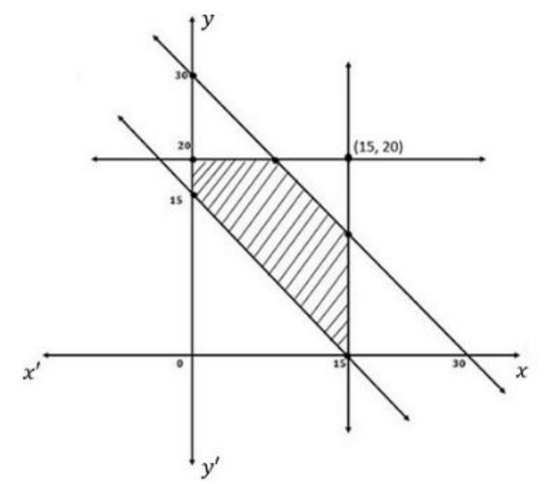
Which one of the following set of constraints does the given shaded region represent?
Answer & explanation
Correct answer: option 1
The correct answer is Option (1) → \(x + y \le 30,\ x + y \ge 15,\ x \le 15,\ y \le 20,\ x, y \ge 0\)
The boundary lines in the figure are:
the line through (30, 0) and (0, 30): \(x + y = 30\)
the line through (15, 0) and (0, 15): \(x + y = 15\)
the vertical line through (15, 20): \(x = 15\)
the horizontal line through (15, 20): \(y = 20\)
The shaded region lies between the two parallel lines, so \(x + y \ge 15\) and \(x + y \le 30\). It lies to the left of x = 15 and below y = 20, so \(x \le 15\) and \(y \le 20\); and it is in the first quadrant, so \(x, y \ge 0\).
As a check, the point (10, 10) inside the shaded region satisfies all of these: \(x + y = 20\), which lies between 15 and 30, \(x = 10 \le 15\) and \(y = 10 \le 20\).
Why the other options are incorrect
Option (2) \(x + y \le 30,\ x + y \ge 15,\ y \le 15,\ x \le 20,\ x, y \ge 0\) — Incorrect. It swaps the bounds on x and y: the vertical boundary is x = 15 and the horizontal one is y = 20, not x = 20 and y = 15.
Option (3) \(x + y \ge 30,\ x + y \le 15,\ x \le 15,\ y \le 20,\ x, y \ge 0\) — Incorrect. No point can have \(x + y \ge 30\) and \(x + y \le 15\) together, so this set has no feasible region at all.
Option (4) \(x + y \ge 30,\ x + y \le 15,\ y \le 15,\ x \le 20,\ x, y \ge 0\) — Incorrect. As in Option (3), \(x + y \ge 30\) and \(x + y \le 15\) cannot hold together.