
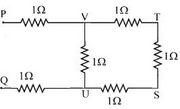
A combination of resistors is shown below. The equivalent resistance between the terminals P and Q is:
Answer & explanation
Correct answer: option 1
The correct answer is Option (1) → \( \displaystyle\frac{11}{4}\,\Omega \)
Reduce the network from the far end by identifying which resistors are in series and which are in parallel. Every resistor in the figure is \( 1\,\Omega \).
Between V and U there are two paths: the direct resistor VU, and the path V → T → S → U through three resistors in series.
\( R_{\mathrm{VTSU}} = 1+1+1 = 3\,\Omega \)
These two paths are in parallel:
\( \displaystyle R_{\mathrm{VU}} = \frac{1\times3}{1+3}\,\Omega = \frac{3}{4}\,\Omega \)
The resistors PV and UQ are in series with this combination.
\( \displaystyle R_{\mathrm{PQ}} = 1 + \frac{3}{4} + 1 = \frac{11}{4}\,\Omega \)