
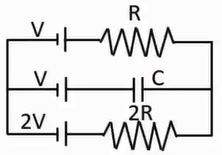
In the given circuit when steady current flows, the potential drop across the capacitor is:
Answer & explanation
Correct answer: option 2
The correct answer is Option (2) → \( V/3 \)
In the steady state a capacitor is fully charged and its branch carries no current. So the current flows only round the loop made by the top branch (\( V \), \( R \)) and the bottom branch (\( 2V \), \( 2R \)). The two cells oppose each other in this loop.
\( \displaystyle I = \frac{2V - V}{R + 2R} = \frac{V}{3R} \)
The current flows the way the \( 2V \) cell drives it, so it goes through the top cell against its emf. Take the left wire at zero potential. Going along the top branch, the potential of the right wire is
\( \displaystyle V_{\mathrm{right}} = V + IR = V + \frac{V}{3R} \times R = \frac{4V}{3} \)
(Check through the bottom branch: \( 2V - I(2R) = 2V - \frac{2V}{3} = \frac{4V}{3} \).)
In the middle branch the cell raises the potential to \( V \) at the left plate of the capacitor, and the right plate is at \( 4V/3 \).
\( \displaystyle V_C = \frac{4V}{3} - V = \frac{V}{3} \)