The function \(f(x)=\displaystyle\frac{-3}{4}x^4-8x^3-\frac{45}{2}x^2 + 163\) has a local maxima at
Answer & explanation
Correct answer: option 3
The correct answer is Option (3) → \(x=0\) and \(x = -5\)
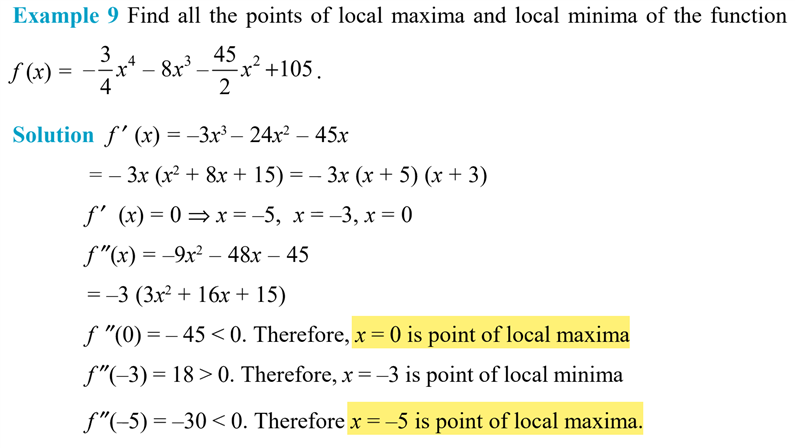
The critical points come from \(f'(x) = 0\):
\(f'(x) = -3x^3 - 24x^2 - 45x\)
\(f'(x) = -3x(x^2 + 8x + 15)\)
\(f'(x) = -3x(x + 3)(x + 5)\)
\(f'(x) = 0 \Rightarrow x = 0,\ -3,\ -5\)
By the second derivative test, with \(f''(x) = -9x^2 - 48x - 45\):
\(f''(0) = -45 \lt 0\): local maximum
\(f''(-3) = -81 + 144 - 45 = 18 \gt 0\): local minimum
\(f''(-5) = -225 + 240 - 45 = -30 \lt 0\): local maximum
So f has local maxima at x = 0 and x = −5.
Why the other options are incorrect
Option (1) \(x=0\) and \(x = 3\) — Incorrect. x = 3 is not a critical point: \(f'(3) = -9 \times 6 \times 8 \ne 0\).
Option (2) \(x=-3\) and \(x = -5\) — Incorrect. x = −3 is a local minimum, since \(f''(-3) \gt 0\).
Option (4) \(x=-3\) — Incorrect. x = −3 is the local minimum.
NCERT Exemplar:
Application of Derivatives