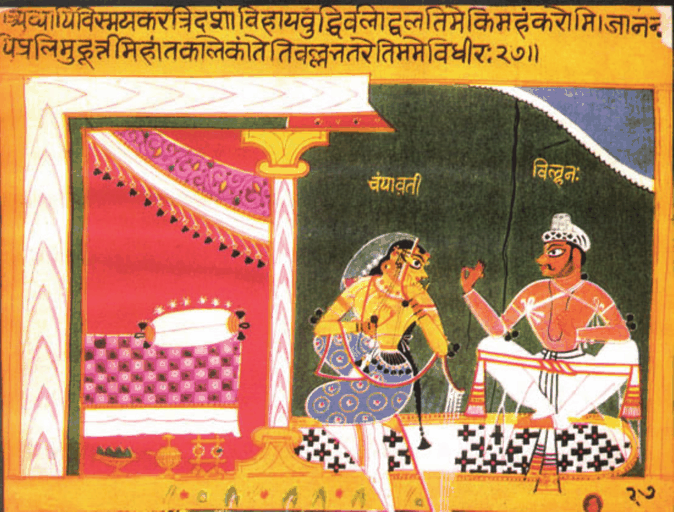
Identify the correct sequence of Indian painting Schools according to their origin.
A. Mughal School
B. Rajasthani School
C. Deccani School
D. Pahari School
E. Bengal School
Choose the correct answer from the options given below:
Answer & explanation
Correct answer: option 2
The correct answer is Option (2) → B, A, C, D, E
The schools are placed by when each tradition began.
B. Rajasthani School — it carries on the indigenous tradition of painting that was there before the Mughals came. The chapter shows the Chaurpanchasika of Mewar, painted in 1500.
A. Mughal School — it begins with the Mughal emperors, the first of whom, Babur, came in 1526.
C. Deccani School — its earliest examples belong to the reign of Hussain Nizam Shah I of Ahmadnagar (1553–1565).
D. Pahari School — its centres grew from the seventeenth to the nineteenth century.
E. Bengal School — it arose in the first decade of the twentieth century.
NCERT (2026-27): “…For Coomaraswamy, the nomenclature represented the indigenous tradition of painting prevalent in the mainland before the conquest by the Mughals.…” “Early Mughal Painting In 1526, Babur, the first Mughal emperor, came from present day Uzbekistan and was a descendent of Emperor Timur and Chatghtai Turk.…” “Ahmadnagar School of Painting The earliest examples of Deccani painting are in a volume of poems, celebrating the reign of Hussain Nizam Shah I of Ahmadnagar (1553–1565).…” “…Pahari Schools of Painting includes towns, such as Basohli, Guler, Kangra, Kullu, Chamba, Mankot, Nurpur, Mandi, Bilaspur, Jammu and others in the hills of western Himalayas, which emerged as centres of painting from seventeenth to nineteenth century.…” “Raja Ravi Varma …With the rise of nationalism in India by the end of the nineteenth century, this academic style embraced by Raja Ravi Varma came to be looked down upon as foreign and too western to show Indian myths and history. It is amidst such nationalist thinking that the Bengal School of Art emerged in the first decade of the twentieth century.”
Chaurpanchasika, Mewar, 1500, N. C. Mehta Collection, Ahmedabad, Gujarat |