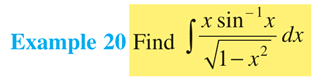
\(\int\displaystyle\frac{x\sin^{-1}x}{\sqrt{1-x^2}}\,dx=\)
Answer & explanation
Correct answer: option 4
The correct answer is Option (4) → \(-\sqrt{1-x^2}\sin^{-1}x+x+C\) where C is arbitrary constant
Let \(t=\sin^{-1}x\), so that
\( x=\sin t \)
\( \displaystyle dt=\frac{dx}{\sqrt{1-x^2}} \)
The integral becomes
\( \displaystyle I=\int t\sin t\,dt \)
Integration by parts, with t as the first function and \(\sin t\) as the second:
\( \displaystyle I=t(-\cos t)-\int 1\cdot(-\cos t)\,dt \)
\( \displaystyle =-t\cos t+\int\cos t\,dt \)
\( = -t\cos t+\sin t+C \)
Back to x: \(\sin t = x\), and since \(-\frac{\pi}{2}\le t\le\frac{\pi}{2}\), \(\cos t\ge 0\), so
\( \cos t=\sqrt{1-x^2} \)
Hence
\( I=-\sqrt{1-x^2}\sin^{-1}x+x+C \)
Why the other options are incorrect
Option (1) \(\sqrt{1-x^2}\cos x+x+C\) where C is arbitrary constant — Incorrect. The first term must contain \(\sin^{-1}x\) (the variable t), not \(\cos x\), and its sign must be minus.
Option (2) \(\sqrt{1-x^2}\sin x+x+C\) where C is arbitrary constant — Incorrect. It has \(\sin x\) in place of \(\sin^{-1}x\), and the sign of the first term is wrong.
Option (3) \(\sqrt{1-x^2}\sin^{-1}x+x+C\) where C is arbitrary constant — Incorrect. This is a sign slip: the integral of \(\sin t\) is \(-\cos t\), so the first term is \(-t\cos t\), with a minus sign.
NCERT (2026-27 edition):
Integration by Parts