Benzene ring in phenol is expected to give the characteristic substitution or replacement reactions, i.e., halogenation, nitration, sulphonation, alkylation, etc. In these reactions, the attacking reagent is electrophile. The phenolic group activates the ortho and para positions in the ring due to conjugation. Disubstitution reactions are quite fast as the electron density in the ring has increased considerably. Phenols do not respond to nucleophilic substitution reactions as it is influenced by phenolic group.
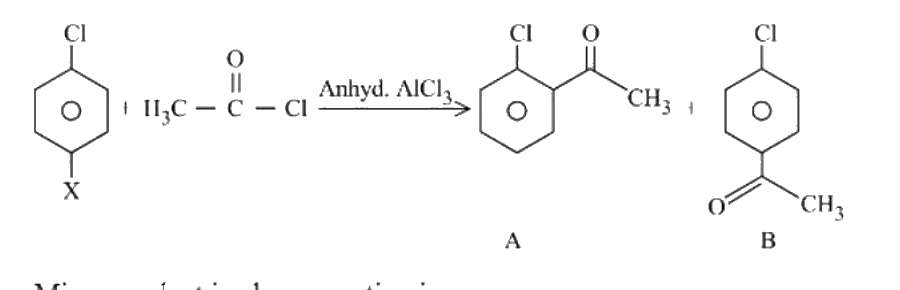
Minor product in the above reaction is:
Answer & explanation
Correct answer: option 1
The correct answer is Option (1) → A
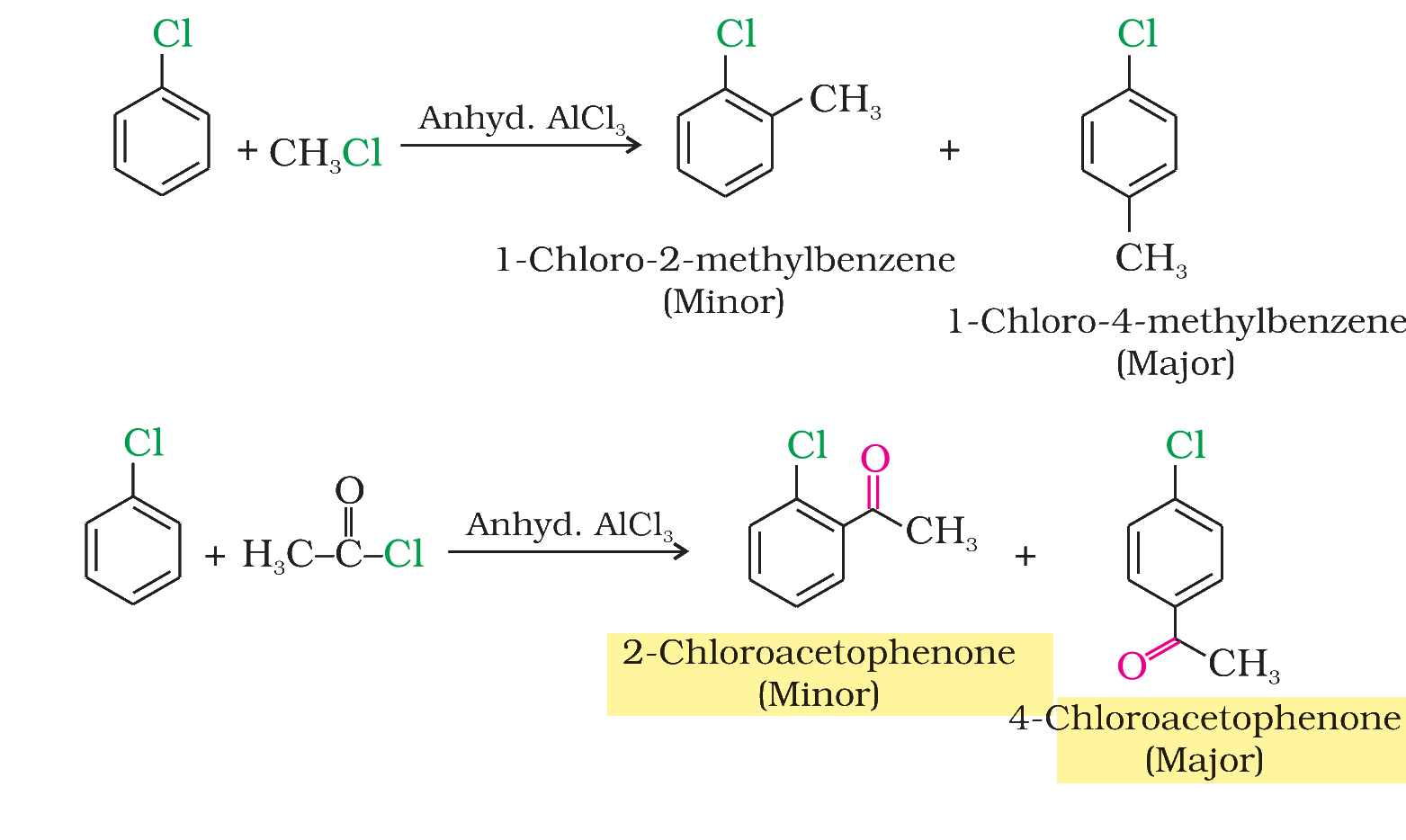
Friedel–Crafts acylation of chlorobenzene with acetyl chloride and anhydrous \( \ce{AlCl3} \) is an electrophilic substitution. Chlorine withdraws electrons by its −I effect, but its lone pairs are released by resonance to the ortho and para positions, so the acetyl group enters there.
\( \ce{C6H5Cl + CH3COCl} \xrightarrow{\text{anhyd. }\ce{AlCl3}} \underset{\text{A (minor)}}{\ce{2-ClC6H4COCH3}} + \underset{\text{B (major)}}{\ce{4-ClC6H4COCH3}} + \ce{HCl} \)
The ortho position is crowded by the chlorine atom (steric hindrance), so the para product B is major and the ortho product A (2-chloroacetophenone) is the minor product.
Why the other options are incorrect
Option (2) B — Incorrect. 4-Chloroacetophenone is the major product, because the para position is free from steric hindrance.
Option (3) A and B in same quantity — Incorrect. Steric hindrance at the ortho position makes the amounts unequal.
Option (4) Depends on quantity of X — Incorrect. The ratio of the products is set by the directing effect of Cl and by steric hindrance, not by the amount of reagent.
NCERT (2026-27 edition):
Friedel-Crafts Reaction