
For the reaction
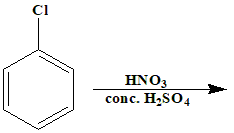
the products is/are:
Answer & explanation
Correct answer: option 4
The correct answer is Option (4) → 1-Chloro-2-nitrobenzene + 1-Chloro-4-nitrobenzene
Conc. \( \ce{HNO3} \) with conc. \( \ce{H2SO4} \) generates the nitronium ion (\( \ce{NO2^{+}} \)), which nitrates the benzene ring. In chlorobenzene the chlorine atom is slightly deactivating (−I effect) but ortho, para-directing: its lone pairs (+R effect) increase the electron density at the ortho and para positions. So a mixture of the two isomers forms, the para isomer being the major product:
\( \ce{C6H5Cl} \xrightarrow[\text{conc. }\ce{H2SO4}]{\text{conc. }\ce{HNO3}} \underset{\text{(minor)}}{\text{o-}\ce{ClC6H4NO2}} + \underset{\text{(major)}}{\text{p-}\ce{ClC6H4NO2}} \)
Why the other options are incorrect
Option (1) 1-Chloro-2-nitrobenzene alone — Incorrect. The ortho isomer is only the minor product; the para isomer also forms, and in larger amount.
Option (2) 1-Chloro-3-nitrobenzene — Incorrect. Chlorine is not a meta-directing group, so the meta isomer is not the product.
Option (3) 1-Chloro-4-nitrobenzene alone — Incorrect. The para isomer is the major product, but the ortho isomer forms along with it, so the products are both isomers.
NCERT (2026-27 edition):
Electrophilic Substitution Reactions – “Haloarenes undergo the usual electrophilic reactions of the benzene ring such as halogenation, nitration, sulphonation and Friedel-Crafts reactions. Halogen atom besides being slightly deactivating is o, p-directing; therefore, further substitution occurs at ortho- and para- positions with respect to the halogen atom.”