What is the structure of anionic coordination sphere in \( [Cr(NH_3)_6][CuCl_5] \) complex?
Answer & explanation
Correct answer: option 1
The correct answer is Option (1) → Trigonal bipyramidal
The compound \( \ce{[Cr(NH3)6][CuCl5]} \) is made of two complex ions: the cation \( \ce{[Cr(NH3)6]^3+} \) and the anion \( \ce{[CuCl5]^3-} \). The charges balance, +3 and −3. In the anion the charge balance gives the oxidation state of copper:
\( \displaystyle x + 5(-1) = -3 \Rightarrow x = +2 \)
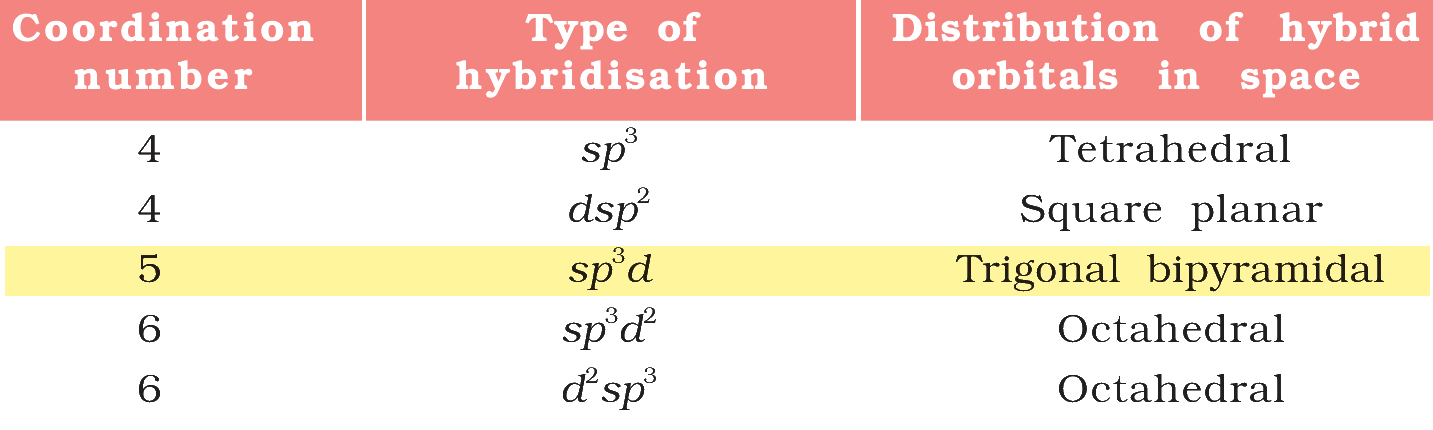
Cu (Z = 29) is \( \mathrm{[Ar]\,3d^{10}\,4s^{1}} \); losing the 4s electron and one 3d electron gives \( \ce{Cu^2+} \): \( \mathrm{3d^{9}} \). Five chloride ligands give a coordination number of 5. The geometry for coordination number 5 in the valence bond theory is that of \( sp^3d \) hybrid orbitals, the trigonal bipyramid: three Cl in an equatorial plane at 120° and two axial Cl above and below it. So the anionic coordination sphere \( \ce{[CuCl5]^3-} \) is trigonal bipyramidal.
Why the other options are incorrect
Option (2) Square pyramidal — Incorrect. Square pyramidal is the other shape known for five ligands, but the \( sp^3d \) hybridisation used for coordination number 5 in the valence bond theory gives the trigonal bipyramid.
Option (3) Tetrahedral — Incorrect. This needs only four ligands (\( sp^3 \)), as in \( \ce{[CuCl4]^2-} \).
Option (4) Square planar — Incorrect. This is also a four-coordinate shape (\( dsp^2 \)), as in \( \ce{[Ni(CN)4]^2-} \).
NCERT (2026-27 edition):
Valence Bond Theory – …