Which of the following cannot be explained by the open chain structure of glucose?
Answer & explanation
Correct answer: option 4
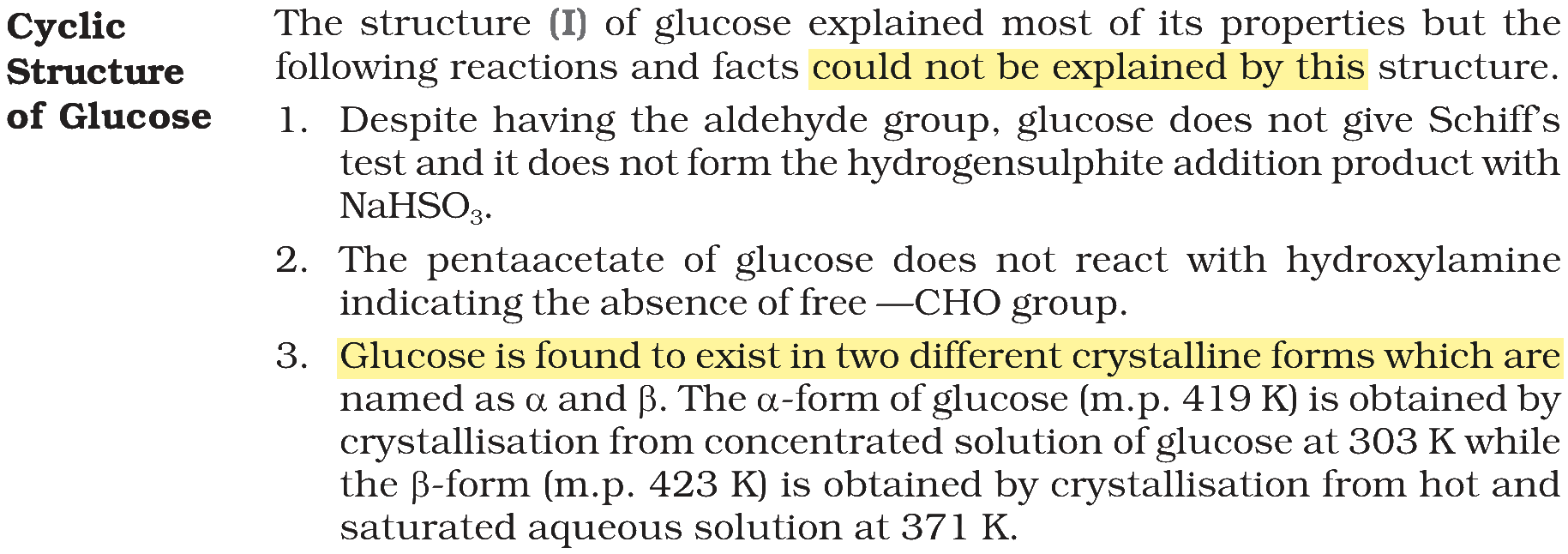
The correct answer is Option (4) → Glucose exists in two forms in nature; \(\alpha\) and \(\beta\).
The open chain structure of glucose has an aldehyde group at C-1, four secondary –OH groups and a primary –OH group: \( \ce{OHC-(CHOH)4-CH2OH} \). It explains many reactions, but not the existence of two crystalline forms, α-glucose (m.p. 419 K) and β-glucose (m.p. 423 K). These are explained by the cyclic hemiacetal structure: the –OH at C-5 adds to the –CHO group to form a six-membered ring, and the new –OH on C-1 (the anomeric carbon) can lie on either side, giving the α and β forms.
Option (1) Glucose reacts with hydroxylamine — Explained by the open chain structure. This shows a carbonyl group, as in the open chain; glucose forms an oxime: \( \ce{OHC-(CHOH)4-CH2OH + NH2OH -> HON=CH-(CHOH)4-CH2OH + H2O} \).
Option (2) Glucose undergoes oxidation with nitric acid — Explained by the open chain structure. Both the –CHO group and the primary –\( \ce{CH2OH} \) group at the chain ends are oxidised to –COOH, giving saccharic acid: \( \ce{OHC-(CHOH)4-CH2OH} \xrightarrow{\ce{HNO3}} \ce{HOOC-(CHOH)4-COOH} \).
Option (3) Glucose reacts with acetic anhydride to form pentaacetyl glucose. — Explained by the open chain structure. Acetylation of all five –OH groups gives the pentaacetate, which confirms the five hydroxyl groups of the open chain.
Option (4) Glucose exists in two forms in nature; \( α \) and \( β \). — Not explained by the open chain structure. The two forms arise from the cyclic hemiacetal, where the new –OH on C-1 can lie on either side.
NCERT (2026-27 edition):
Cyclic Structure of Glucose – …