
Pick the incorrect statement about aniline.
1. Forms Zwitter ion when heated with conc. \(H_2SO_4\)
2. Does undergo alkylation or acylation
3. Undergoes diazotization
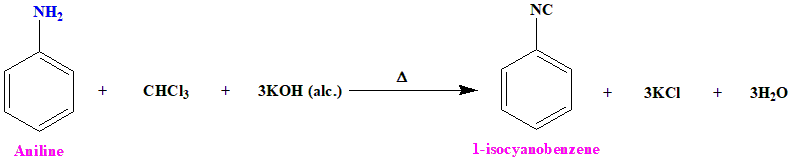
4. Produces foul smell when heated with chloroform and ethanolic \(KOH\)
Answer & explanation
Correct answer: option 2
The correct answer is option 2. Does undergo alkylation or acylation.
Aniline \(C_6H_5NH_2\) is an organic compound, specifically an aromatic amine. Let us look at each of the given statement:
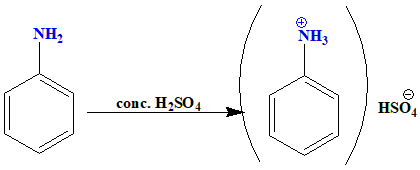
1. Forms Zwitter ion when heated with conc. \(H_2SO_4\):
This statement is true. When aniline is heated with concentrated sulfuric acid (\(H_2SO_4\)), it undergoes a protonation reaction to form an anilinium ion \(C_6H_5NH_3^+\), which is a type of zwitterion. This occurs because the amine group \(NH_2\) in aniline can act as a base and accept a proton \(H^+\) from the sulfuric acid.
2. Does undergo alkylation or acylation:
This statement is incorrect. Aniline forms salt with the Lewis acid catalyst i.e., \(AlCl_3\), which is used in Friedel-Crafts reaction (i.e., Alkylation and acylation). Nitrogen of aniline acquires positive charge and hence acts as a strong deactivating group for further reaction.
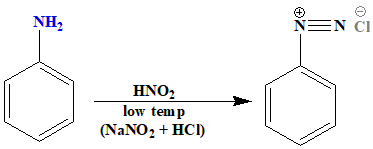
3. Undergoes diazotization:
This statement is true. Aniline can undergo diazotization, a chemical reaction in which the primary aromatic amine group \(-NH_2\) is converted to a diazonium salt \(-N_2^+X^-\) by treatment with nitrous acid \((HNO_2)\) under acidic conditions. This reaction is commonly used in organic synthesis to introduce the diazonium group, which can further react with various nucleophiles to form azo compounds, among other products.
4. Produces foul smell when heated with chloroform and ethanolic \(KOH\):
This statement is true. When aniline is heated with chloroform \((CHCl_3)\) and ethanolic potassium hydroxide (\(KOH\)), it undergoes a reaction known as the Hofmann degradation. This reaction results in the formation of an isocyanide compound, which has a foul smell resembling that of mustard oil or rotten fish.
Therefore, statement 2 is incorrect.