
The maximum value of z = 4x + 2y subject to constraints
2x + 3y ≤ 28,
x + y ≤ 10,
x, y ≥ 0 is :
Answer & explanation
Correct answer: option 2
Z = 4x + 2y
x, y ≥ 0 ⇒ solution in 1st quadrant
plotting lines first
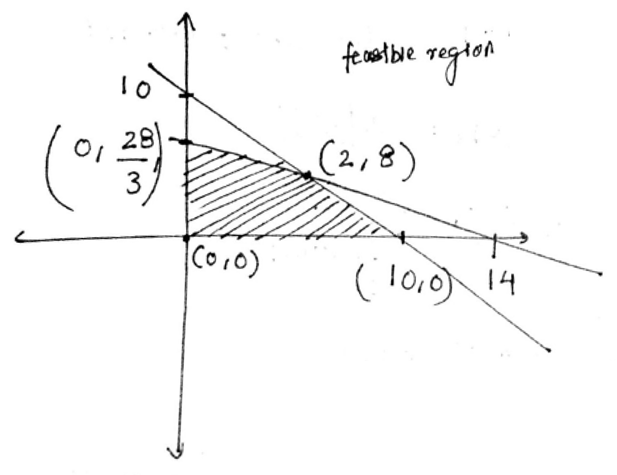
2x + 3y = 28
| x | 14 | 0 |
| y | 0 | $\frac{28}{3}$ |
x + y = 10
| x | 10 | 0 |
| y | 0 | 10 |
Checking point O(0, 0)
1. for 2x + 3y ≤ 28
⇒ 0 ≤ 28 (true)
solution lies to side containing (0, 0)
2. x + y ≤ 10
⇒ 0 ≤ 10 (true)
solution lies to side containing (0, 0)
| Corner points | Function |
| (x, y) | Z(x, y) = 4x + 2y |
| (0, 0) | Z(0, 0) = 0 + 0 = 0 |
| (10, 0) | Z(10, 0) = 40 + 0 = 40 → Zmax |
| (0, $\frac{28}{3}$) | Z(0, $\frac{28}{3}$) = 0 + $\frac{56}{3}$ = $\frac{56}{3}$ |
| (2, 8) | Z(2, 8) = 8 + 16 = 24 |