Match List - I with List - II.
| LIST-I (Market Related Concepts) | LIST-II (Characteristics/Egs) | ||
| (A) | Free Market | (I) | Commodification |
| (B) | Capitalism | (II) | 'Haat' |
| (C) | Weekly Market | (III) | Virtual market |
| (D) | NASDAQ | (IV) | 'Laissez-faire' |
Choose the correct answer from the options given below:
Answer & explanation
Correct answer: option 4
The correct answer is Option (4) → (A)-(IV), (B)-(I), (C)-(II), (D)-(III)
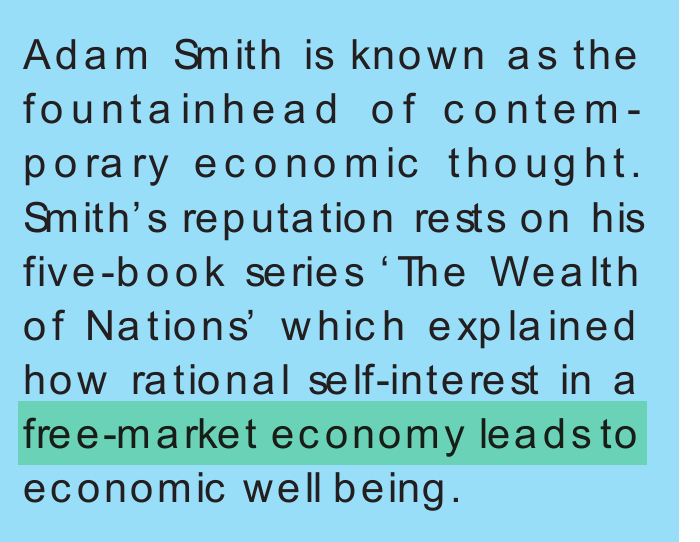
(A) Free Market — this matches (IV) ‘Laissez-faire’. Adam Smith supported the idea of a ‘free market’, a market free from all kinds of regulation; this economic philosophy was given the name laissez-faire, a French phrase meaning ‘leave alone’ or ‘let it be’.
(B) Capitalism — this matches (I) Commodification. The growth of capitalism has extended markets into new spheres of life. Commodification occurs when things that were earlier not traded in the market become commodities, such as labour or skills.
(C) Weekly Market — this matches (II) ‘Haat’. The weekly haat brings together people from surrounding villages to sell their produce and buy goods not available in their villages.
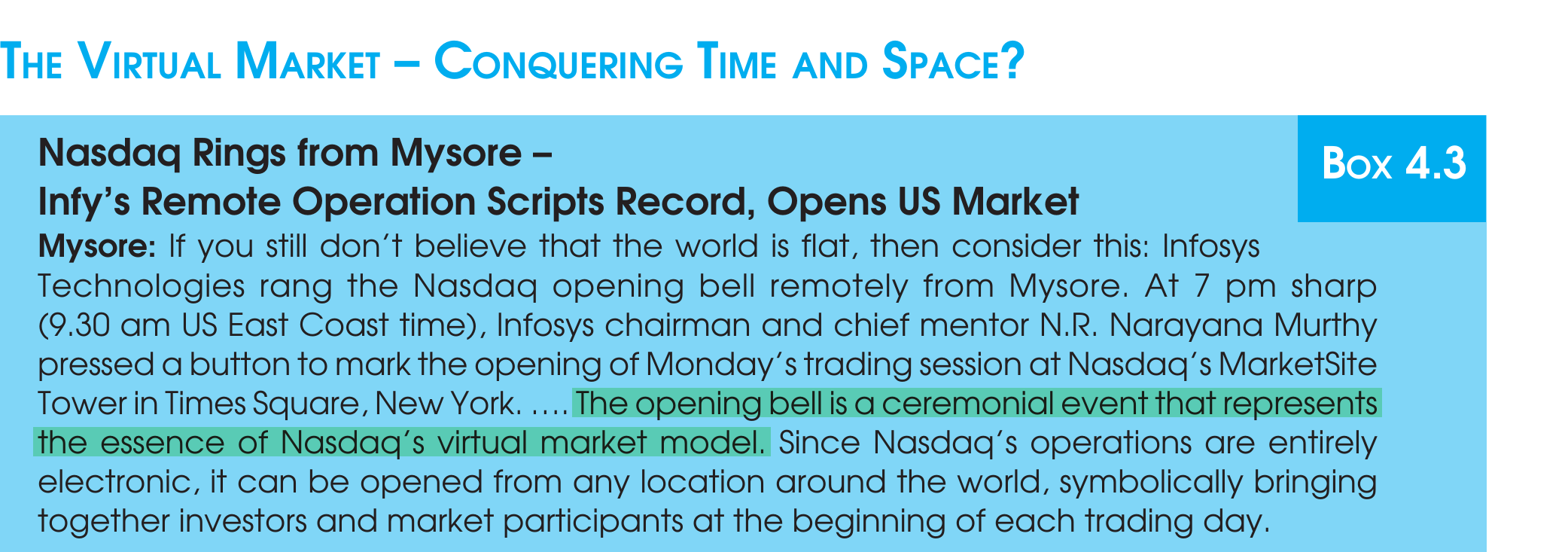
(D) NASDAQ — this matches (III) Virtual market. The Nasdaq is a global trading network where shares are traded electronically; the pre-rationalised book shows it under the heading ‘The Virtual Market’, when Infosys rang the Nasdaq opening bell from Mysore.
Note: In the chapter ‘The Market as a Social Institution’, the lines that give Adam Smith’s free market the name ‘laissez-faire’ and Box 4.3 ‘The Virtual Market’, on the Nasdaq, were there in the pre-rationalised NCERT, which NTA followed in 2023. These portions have been deleted from the NCERT book (2025-26), though the chapter is still there and still speaks of Adam Smith’s free-market economy, commodification, the weekly haat and the Nasdaq.
NCERT (2025-26): “A weekly ‘tribal market’ in Dhorai village, Bastar, Chattisgarh … In most agrarian or ‘peasant’ societies around the world, periodic markets are a central feature of social and economic organisation. Weekly markets bring together people from surrounding villages, who come to sell their agricultural or other produce and to buy manufactured goods and other items that are not available in their villages.…” “The weekly haat is a common sight in rural and even urban India. In hilly and forested areas (especially those inhabited by adivasis), where settlements are far-flung, roads and communications poor, and the economy relatively undeveloped, the weekly market is the major institution for the exchange of goods as well as for social intercourse.…” “Commoditisation and Consumption … The growth of capitalism around the world has meant the extension of markets into places and spheres of life that were previously untouched by this system. Commodification occurs when things that were earlier not traded in the market become commodities. For instance, labour or skills become things that can be bought and sold.…” “…There are many different ways and levels at which goods, services, cultural symbols, money, and so on, circulate — from the local market in a village or town right up to a global trading network such as the Nasdaq.…” NCERT (Pre-rationalised): “4.1 Sociological Perspectives on Markets … Smith used the idea of the ‘invisible hand’ to argue that society overall benefits when individuals pursue their own self-interest in the market, because it stimulates the economy and creates more wealth. For this reason, Smith supported the idea of a ‘free market’, that is, a market free from all kinds of regulation whether by the state or otherwise. This economic philosophy was also given the name laissez-faire, a French phrase that means ‘leave alone’ or ‘let it be’.…”
Margin box on Adam Smith (NCERT 2025-26)
Box 4.3, The Market as a Social Institution (Pre-rationalised NCERT) |