In the following reaction
\(aX \longrightarrow bY\) \(\log_{10}\left(-\frac{dx}{dt}\right) = \log_{10}\left(\frac{dy}{dt}\right) + 0.4771\)
\(X\) and \(Y\), respectively can be
[Given: log3 = 0.4771]
Answer & explanation
Correct answer: option 1
The correct answer is Option (1) → C2H2 and C6H6
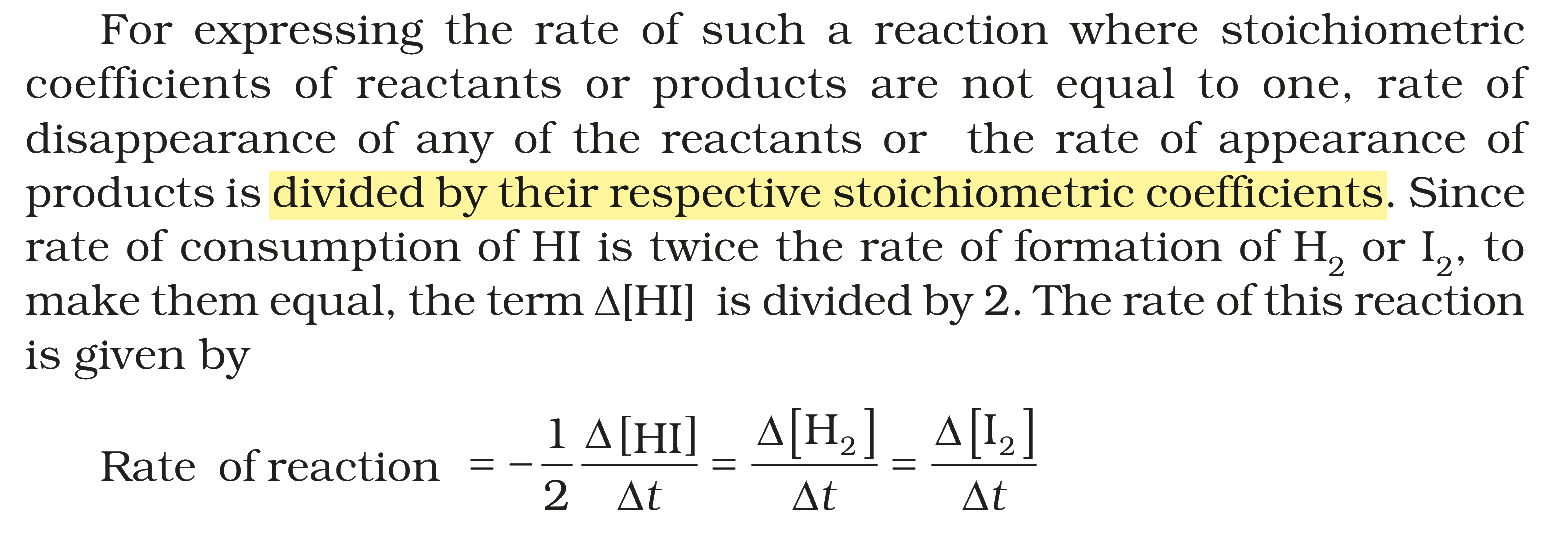
For a reaction aX → bY, the rate of reaction is the same whichever species is used, once each rate is divided by its stoichiometric coefficient:
\( \displaystyle \text{Rate} = -\frac{1}{a}\frac{dx}{dt} = \frac{1}{b}\frac{dy}{dt} \;\Rightarrow\; -\frac{dx}{dt} = \frac{a}{b}\,\frac{dy}{dt} \)
Taking logarithms:
\( \displaystyle \log_{10}\left(-\frac{dx}{dt}\right) = \log_{10}\left(\frac{dy}{dt}\right) + \log_{10}\frac{a}{b} \)
Comparing with the given equation, log(a/b) = 0.4771 = log 3, so a/b = 3: three molecules of X give one molecule of Y.
Acetylene trimerises to benzene (red-hot iron tube, 873 K):
\( \ce{3C2H2} \xrightarrow[\text{873 K}]{\text{red hot iron tube}} \ce{C6H6} \)
Here a = 3, b = 1, so X and Y are C2H2 and C6H6.
Why the other options are incorrect
Option (2) Pentane and 2,2-Dimethylpropane — Incorrect. Isomerisation, \( \ce{C5H12} \) → \( \ce{C5H12} \); a/b = 1, and log 1 = 0.
Option (3) O2 and O3 — Incorrect. \( \ce{3O2} \) → \( \ce{2O3} \); a/b = 3/2, and log 1.5 = 0.176.
Option (4) N2O4 and NO2 — Incorrect. \( \ce{N2O4} \) → \( \ce{2NO2} \); a/b = 1/2, and log 0.5 = −0.301.
NCERT (2026-27 edition):
Rate of a Chemical Reaction – …