Match List I with List II
| LIST I | LIST II |
| (A) Marginal utility | (I) Δy / Δx |
| (B) Marginal Rate of Substitution | (II) (2, 4) < (3, 4) |
| (C) Slope of Budget line | (III) Satisfaction derived from consumption of one additional unit of commodity |
| (D) Monotonic Preferences | (IV) Ratio of prices of 2 goods |
Choose the correct answer from the options given below:
Answer & explanation
Correct answer: option 4
The correct answer is Option (4) → A-III, B-I, C-IV, D-II
Each term describes how a consumer chooses between two goods with a given income.
| List-I | List-II | Reason |
|---|---|---|
| (A) Marginal utility | (III) Satisfaction derived from consumption of one additional unit of commodity | Marginal utility (MU) is the change in total utility from one more unit of a good. |
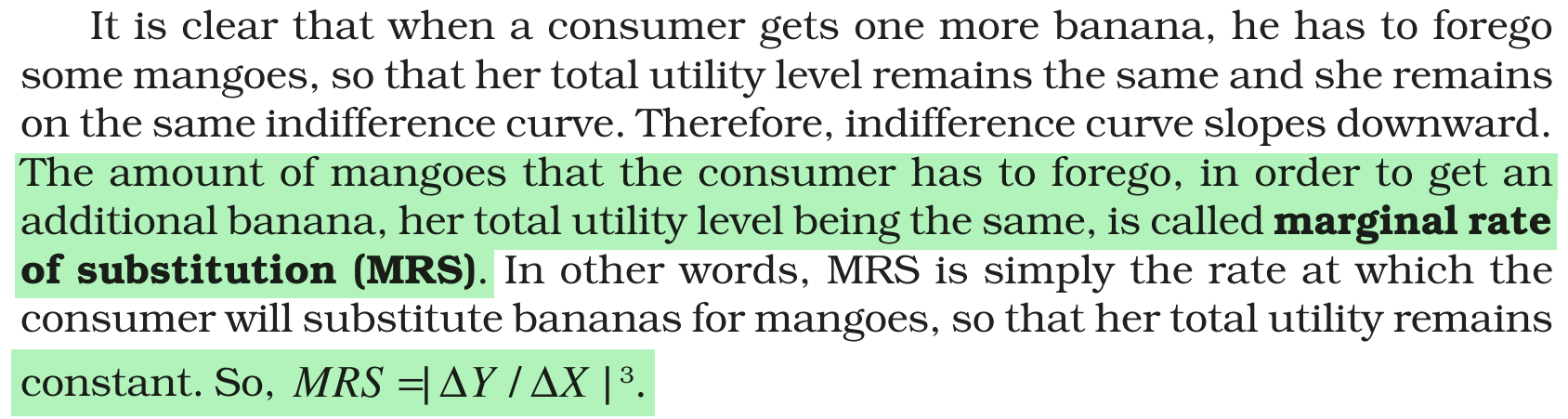
| (B) Marginal Rate of Substitution | (I) Δy / Δx | The marginal rate of substitution (MRS) is the amount of one good given up for one more unit of the other, with utility the same. |
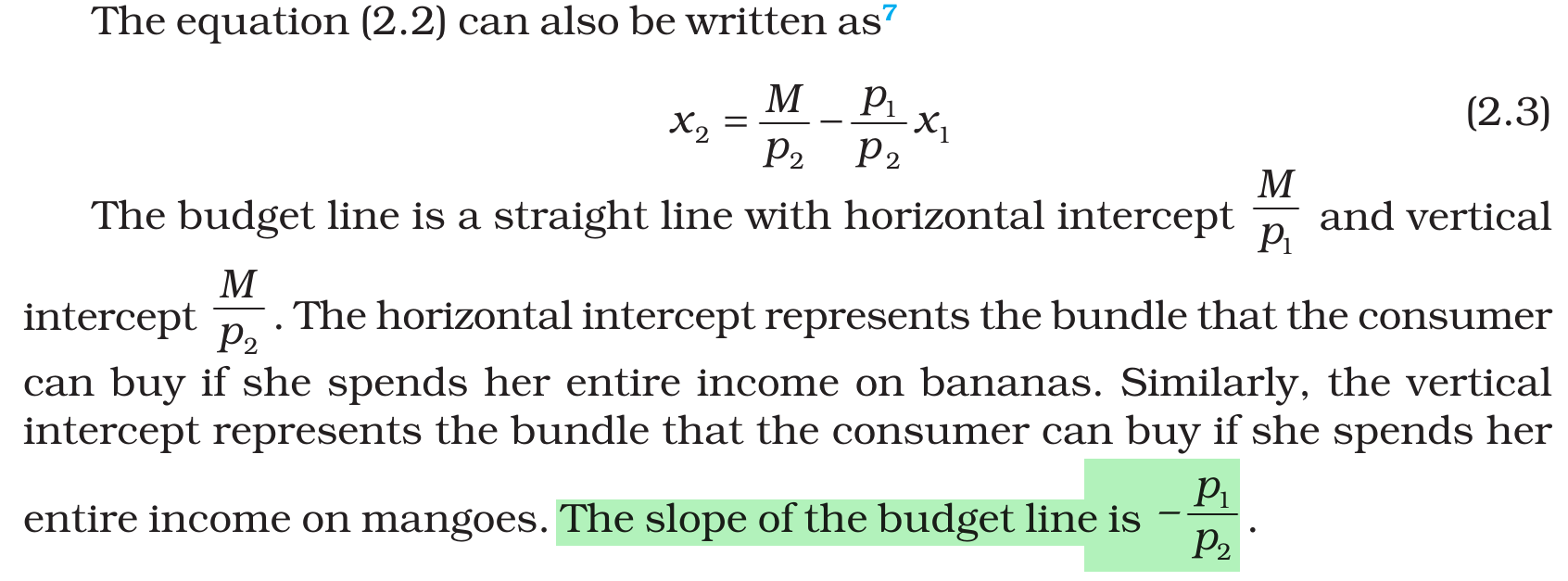
| (C) Slope of Budget line | (IV) Ratio of prices of 2 goods | The slope of the budget line is −p1/p2, the price ratio of the two goods. |
| (D) Monotonic Preferences | (II) (2, 4) < (3, 4) | A bundle with more of one good and no less of the other is preferred, so (3, 4) is preferred to (2, 4). |
NCERT (2026-27): “Marginal Utility: Marginal utility (MU) is the change in total utility due to consumption of one additional unit of a commodity. For example, suppose 4 bananas give us 28 units of total utility and 5 bananas give us 30 units of total utility. Clearly, consumption of the 5th banana has caused total utility to increase by 2 units (30 units minus 28 units).… Monotonic Preferences Consumer’s preferences are assumed to be such that between any two bundles (x1, x2) and (y1, y2), if (x1, x2) has more of at least one of the goods and no less of the other good compared to (y1, y2), then the consumer prefers (x1, x2) to (y1, y2). Preferences of this kind are called monotonic preferences.…”
|